Bb bass in Sousa's band
-
acemorgan
- bugler

- Posts: 33
- Joined: Thu Oct 04, 2018 5:17 pm
- Location: Tucson, where tacos are real
Bb bass in Sousa's band
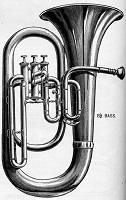
On IMSLP, there are several versions of The Washington Post march, including one from 1889, that includes a "Bb Bass (or trombone)" part, as well as a Bass part. Anyone know what instrument this was supposed to be? In 1889, some catalogs listed euphoniums as Bb basses (my avatar). Is this the instrument Sousa (or the arranger) had in mind?
You do not have the required permissions to view the files attached to this post.
Last edited by acemorgan on Thu Apr 02, 2020 8:47 pm, edited 1 time in total.
Previously:
Reynolds TB-14
Mirafone (yes, with an F) 186
Currently:
Wessex Dolce Tenor Tuba
Reynolds TB-14
Mirafone (yes, with an F) 186
Currently:
Wessex Dolce Tenor Tuba
-
GC

- 5 valves

- Posts: 1800
- Joined: Fri Mar 19, 2004 5:52 am
- Location: Rome, GA (between Rosedale and Armuchee)
Re: Bb bass in Sousa's band
Practice in the mid to fairly late 1800's in US brass writing assumed three instruments in what we would call the baritone range: tenor, baritone, and bass horns, all in the same pitch range. Tenor was a small-bore, small throat horn with a brighter, almost trombone-like tone. Baritones were wider throated and bored, basses were more in the euphonium size and shape range. They were differentiated by tone quality rather than pitch. The bottom instrument was usually called an Eb contrabass. During the latter quarter of the 1800's, lower-pitched BBb contrabass instruments began to become common. Somewhere along the way people began commonly calling them tubas (or helicons or Sousaphones).
The tessitura of bands in that era was higher than today. The upper clarinets and cornets were Eb sopranos. The bottom range instruments were generally in Eb. Starting with the addition of BBb tubas and the gradual motion away from Eb soprano instruments, the pitch range of the band became what it is today.
Bands that specialize in 1800's and early 1900's music typically have Eb soprano cornets or trumpets when called for (even the occasional Eb soprano flugelhorn). British brass bands generally have one Eb soprano, typically used as a color instrument, and they use separate baritone and euphonium parts (and the instruments are different). They also use separate Eb and BBb bass parts. Only rare concert band pieces use Eb trumpet or cornet (Eb soprano clarinet's not that uncommon), different baritone and euphonium parts (pretty much interchangeable), or separate tuba parts beyond written octaves or fifths. Tenor horn parts in British brass parts mean what Americans typically call Eb alto horn parts. It can definitely get confusing.
The tessitura of bands in that era was higher than today. The upper clarinets and cornets were Eb sopranos. The bottom range instruments were generally in Eb. Starting with the addition of BBb tubas and the gradual motion away from Eb soprano instruments, the pitch range of the band became what it is today.
Bands that specialize in 1800's and early 1900's music typically have Eb soprano cornets or trumpets when called for (even the occasional Eb soprano flugelhorn). British brass bands generally have one Eb soprano, typically used as a color instrument, and they use separate baritone and euphonium parts (and the instruments are different). They also use separate Eb and BBb bass parts. Only rare concert band pieces use Eb trumpet or cornet (Eb soprano clarinet's not that uncommon), different baritone and euphonium parts (pretty much interchangeable), or separate tuba parts beyond written octaves or fifths. Tenor horn parts in British brass parts mean what Americans typically call Eb alto horn parts. It can definitely get confusing.
JP/Sterling 377 compensating Eb; Warburton "The Grail" T.G.4, RM-9 7.8, Yamaha 66D4; for sale > 1914 Conn Monster Eb (my avatar), ca. 1905 Fillmore Bros 1/4-size Eb, Bach 42B trombone
-
acemorgan
- bugler
- Posts: 33
- Joined: Thu Oct 04, 2018 5:17 pm
- Location: Tucson, where tacos are real
Re: Bb bass in Sousa's band
I appreciate the detailed reply. Higher tessitura--very interesting; and that explains a lot.
Previously:
Reynolds TB-14
Mirafone (yes, with an F) 186
Currently:
Wessex Dolce Tenor Tuba
Reynolds TB-14
Mirafone (yes, with an F) 186
Currently:
Wessex Dolce Tenor Tuba
-
Donn

- 6 valves

- Posts: 5977
- Joined: Fri Aug 19, 2005 3:58 pm
- Location: Seattle, ☯
Re: Bb bass in Sousa's band
In the parts I've seen, commonly that's called "3rd trombone", and the Bb Bass is the same notes but Bb treble clef.
I don't think I've ever seen the term "Eb contrabass" before, but plenty times the only tuba part has been labelled "Eb Bass".
I don't think I've ever seen the term "Eb contrabass" before, but plenty times the only tuba part has been labelled "Eb Bass".
-
GC
- 5 valves
- Posts: 1800
- Joined: Fri Mar 19, 2004 5:52 am
- Location: Rome, GA (between Rosedale and Armuchee)
Re: Bb bass in Sousa's band
Sousa's arrangements and compositions were marked "Bass", and as the instruments developed they stayed "Bass" but included more low register or kept divided octaves. A lot of pre-Sousa works used "Eb Contrabass" or "Eb Bass", or just "Bass". I don't remember seeing "Tuba" on parts before the 1880's. I spent a lot of years in a Civil War band playing Eb bass parts on period
Eb contrabass Saxhorns.
https://www.bandmusicpdf.org/ has tons of music from the late 1800's on, and it's interesting to look at how Sousa's scoring practices changed through the years.
Eb contrabass Saxhorns.
https://www.bandmusicpdf.org/ has tons of music from the late 1800's on, and it's interesting to look at how Sousa's scoring practices changed through the years.
JP/Sterling 377 compensating Eb; Warburton "The Grail" T.G.4, RM-9 7.8, Yamaha 66D4; for sale > 1914 Conn Monster Eb (my avatar), ca. 1905 Fillmore Bros 1/4-size Eb, Bach 42B trombone