Page 1 of 2
Pedal Tones (Physics Perspective)???
Posted: Tue May 13, 2014 10:36 am
by bud
Hi friends,
I would be grateful for your explanations.
In preparing to help a Physics teacher teach the harmonic series with my tuba, I'm finding that I have some misconceptions about the physics of the tuba. I would have told the students that my pedal C, 32.7 hz, is the fundamental, Harmonic 1 (H1), for the 16 ft tube. But check out the Wikipedia article I've copied and pasted below. It sums up concisely what I'm finding on Physics websites as well. I put in bold the parts that I find especially tragic to my previous conceptions.
Pedal tones are special notes in the harmonic series of cylindrical-bore brass instruments. A pedal tone has the pitch of its harmonic series' fundamental tone. Its name comes from the pedals of a pipe organ. Cylindrical brasses do not naturally vibrate at this frequency.
A closed cylinder (tubas are closed since our mouths our on one end) vibrates at only the odd members of its harmonic series. This set of pitches is too sparse to be musically useful for brass instruments; therefore, the bells and mouthpieces of brasses are crafted to adjust these pitches. The bell significantly raises all pitches in the series, and the mouthpiece limits the amount to which higher harmonics are raised. The resulting set of pitches is a new harmonic series altogether. This new series has all but one of its members present, instead of only the odd members.
The member not present in the new series is the fundamental. The original fundamental is not raised all the way to the new fundamental pitch, and the original third harmonic becomes the new second harmonic.
The new fundamental can be played, however, as a pedal tone. The higher resonances of the new series help the lips vibrate at the fundamental frequency and allow the pitch to sound. The resulting tone relies heavily on overtones for its perception, but in the hands of a skilled player, pedal tones can be controlled and can sound characteristic to the instrument.
Pedal tones are called for occasionally in advanced brass repertoire, particularly in that of the trombone and especially the bass trombone.
So if C two ledger lines below the bass clef staff is the original H3 of a straight tube (now H2), can I play the original H1 and H2? I can get my tuba cranking on F, 4 ledger lines down (what we call a "false tone") and C (what we call a "pedal tone"), but those are not the original (straight tube) H1 and H2. Are the original (straight tube) H1 and H2 so low that I can't play them? My chops can hold a steady tone all the way down to E! The H1 and H2 are lower than that?
Do I understand right that with pedal C, the tuba is not vibrating the C 32.7 hz, itself, even though I'm buzzing 32.7 hz? What does "relying on the overtones" mean exactly? The tuba is sympathetically resonating the higher harmonics, yes, but I sure do hear C, 32.7 hz.
Thanks,
Bud
Re: Pedal Tones (Physics Perspective)???
Posted: Tue May 13, 2014 10:59 am
by tbn.al
There are so many misconceptions out there that it is hard to answer your question. For instance here is a Wiki article purportedly from Dayton University that flies in the face of what I was taught.
"For cylindrical bore brass (e.g. trumpet, trombone), the second harmonic is the lowest playable note. The
fundamental is technically playable on a trumpet or trombone, but not in context, as it is extremely difficult
to play. On a conical bore brass instrument (e.g. flugelhorn, horn, tuba) the fundamental is available, but is a
somewhat special note called a "pedal tone" or "pedal note" and is rarely called for in written music. This is
probably because the valving system of a brass instrument usually only allows the lowering of the pitch to a
tritone below the open sounding pitch, which means that there are five notes above the fundamental that
cannot be played."
As a bass trombone player I can vouch for the viability of pedal tones in cylindrical brass instruments.
Re: Pedal Tones (Physics Perspective)???
Posted: Tue May 13, 2014 11:15 am
by Jay Bertolet
I could go through those two Wiki articles and specify what I agree with and what I don't. Honestly, I don't understand enough about acoustical physics (other than what I know from empirical experimentation I have personally done, i.e. my playing experiences) to refute or confirm any of those statements scientifically. I think the more important concept to realize is that today, in 2014, we still don't understand all there is to know about how these things really work and that continued study and work will be required if we expect to approach a level of understanding that allows us to make credible statements about these concepts.
Re: Pedal Tones (Physics Perspective)???
Posted: Tue May 13, 2014 11:52 am
by NCSUSousa
Bud,
If you're into reading science papers, try this one:
http://www.phys.unsw.edu.au/jw/reprints/AAclarinet.pdf
Rick Denney's page may help in visualizing the actual waveform and describing what you're really hearing on a low note:
http://www.rickdenney.com/the_tuba_sound.htm
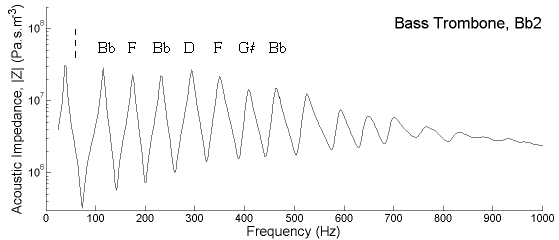
One very important point - the bell flare affects the resonant overtone series. It helps move the frequencies closer together - making them more playable if the instrument was designed correctly. You can see this by comparing the trombone series below to the clarinet paper I referenced in my first link. The effect for a HS physics class is this - the standard cylinder based calculations don't work.
Here's a link (and image) that show the fundamental series of a trombone at the fully in slide position. They didn't mark the lowest one (the pedal Bb) for this article, but they acknowledge elsewhere that it is playable by experienced players.
http://www.phys.unsw.edu.au/jw/brassaco ... cimpedance
Re: Pedal Tones (Physics Perspective)???
Posted: Tue May 13, 2014 12:27 pm
by Donn
Among band instruments, the "closed cylinder" model applies only to the clarinet family. As a consequence of the roughly cylindrical bore and the reed tone generator, the clarinet features only odd partials. Hence, the unusually high 2nd register - where a saxophone or flute's 2nd register is the octave (2nd partial), the clarinet is the octave + a fifth (3rd partial.) And the distinctive "hollow" tone is the closed cylinder tonal signature, I suppose.
Of course we're talking about a couple different things here. If I have the chops to play in the pedal range, I think of that as the pitch associated with the first partial (because that's what "pedal" means to me.) Whether or not an analysis of the tone would show any actual first partial, is not really of any practical consequence to me, since that machine is not my ordinary audience.
Re: Pedal Tones (Physics Perspective)???
Posted: Tue May 13, 2014 12:43 pm
by NCSUSousa
Donn wrote:Among band instruments, the "closed cylinder" model applies only to the clarinet family. As a consequence of the roughly cylindrical bore and the reed tone generator, the clarinet features only odd partials. Hence, the unusually high 2nd register - where a saxophone or flute's 2nd register is the octave (2nd partial), the clarinet is the octave + a fifth (3rd partial.) And the distinctive "hollow" tone is the closed cylinder tonal signature, I suppose.
Of course we're talking about a couple different things here. If I have the chops to play in the pedal range, I think of that as the pitch associated with the first partial (because that's what "pedal" means to me.) Whether or not an analysis of the tone would show any actual first partial, is not really of any practical consequence to me, since that machine is not my ordinary audience.
Edit - After looking into this a bit more, I see why the physicists are considering the tuba as a closed pipe resonator. When you add the player, there is a closed end
to the system. Sure the tuba is open at both ends, but the mouthpiece end is connected to your mouth. While your lips are together during the buzz, the mouthpiece bowl is the closed end of the pipe. While your lips are open (again, milliseconds during the buzz), the end of the 'pipe' is your chest cavity.
This is why playing technique can result in the need to cut a tuning slide - you're actually increasing the effective length of the tuba when playing with an open air pathway if you're taking in as much air as you should. (<--Arnold Jacobs method anyone?)
Re: Pedal Tones (Physics Perspective)???
Posted: Tue May 13, 2014 1:03 pm
by NCSUSousa
After doing some looking, I ran into one other really big point -
That 32.7hz C1 has a wavelength of almost 35 ft. That's more than 2x the length of the 16' CC tuba and 2x more than the resonant frequency for a 16' open cylinder tube. It is close to the 1st resonant frequency (fundamental harmonic) closed pipe resonance calculation for a 16' cylinder (32'). Of course the bell effect and conical bore on the tuba change that resonant point by ~10% (from 32' to 35' wavelength).
This also helps explain why it's really hard to play low notes sitting in my living room, but I can play them fairly easily in a larger space - they need more free air to resonate than what's available in my tuba.
Bud, based on this calculation - you're 100% correct. 32.7hz is the fundamental resonant frequency for your tuba (no valves in use)
because it is a closed pipe resonator. The fact that the fundamental frequency is 32.7hz instead of 35.313hz is a function of the tuba being a conical shape with a bell instead of it being a pure cylinder.
Here's a wavelength calculator that will give you a length in feet, inches or meters -
http://www.mcsquared.com/wavelength.htm
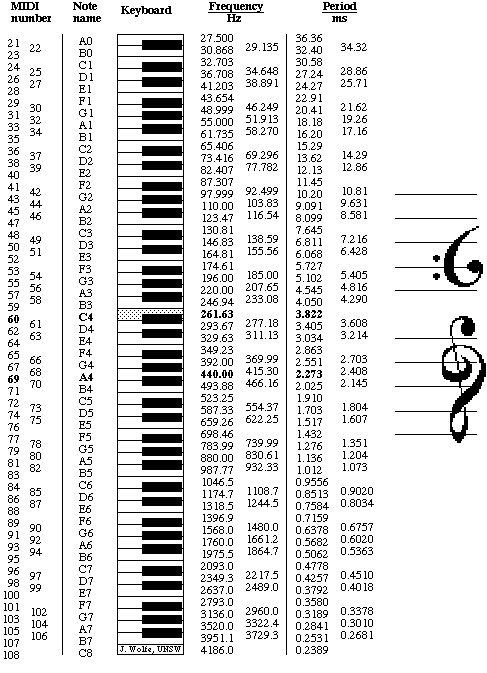
Here's a good midi reference chart that gives the note name, frequency and a piano keyboard for reference:
Re: Pedal Tones (Physics Perspective)???
Posted: Tue May 13, 2014 2:25 pm
by Donn
So there seem to be two different acoustical models here? I'm actually accustomed to the term "stopped pipe" for the clarinet family. Same thing? If so, why do our registers follow the whole series, including the even partials that ought to be cancelled out - and are cancelled out in the clarinet family?
Re: Pedal Tones (Physics Perspective)???
Posted: Tue May 13, 2014 3:13 pm
by NCSUSousa
Everything I've read points to the idea that the conical shape and the bell effect coupled with a mouthpiece effect in brass instruments are changing the resonant frequencies across the entire spectrum of an instrument enough that the resonant frequencies of the stopped pipe are moved close enough together for usefulness in making music. The end result is that the steps in the harmonic series for a good instrument actually end up where they would be for an open cylinder while also maintaining the directional projection and overall amplification advantages given by the shapes used.
The different acoustic model for the flute seems to be an abnormal model for a wind instrument. Of course, it requires a lot of air relative to the amount of sound output on a flute. Most wind instruments are far more efficient.
There's a better set of images showing what we really deal with here (this time adding a soprano sax to the equation):
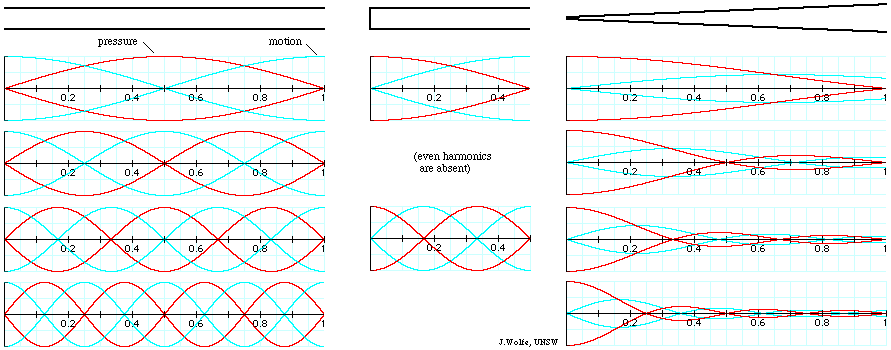
On this image, they've circled the note that you hear on the impedance graph:
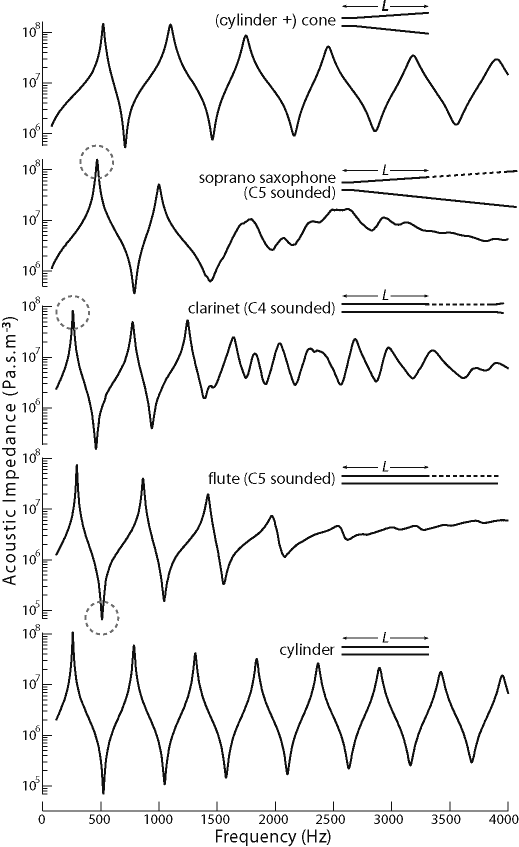
Here's the link if you want to see the whole webpage:
http://www.phys.unsw.edu.au/jw/pipes.html
Sidebar - I think this dependency on the bore profile also explains just how many different ways there are to make a tuba. Since it's conical for the majority of the instrument there are many ways to get to a useable instrument. There are also many ways to screw up a copy of a good tuba - as evidenced by those early F tubas from China that everyone seems to hate and declare to have horrible intonation against itself. If it was as simple as adding a little cylindrical tubing here or there to fix a tuning issue for the entire harmonic series, everyone would be able to build a good tuba.
Donn wrote:So there seem to be two different acoustical models here? I'm actually accustomed to the term "stopped pipe" for the clarinet family. Same thing? If so, why do our registers follow the whole series, including the even partials that ought to be cancelled out - and are cancelled out in the clarinet family?
Re: Pedal Tones (Physics Perspective)???
Posted: Tue May 13, 2014 7:00 pm
by DonShirer
I have at least a dozen books on musical acoustics on my shelf that I accumulated over my career as a physics teacher and most of them are a little shaky, if not wrong, when discussing actual musical instruments. May I recommend one of the better ones, intended for the non-scientist, Arthur Benade's "Horns, Strings & Harmony", an out-of-print paperback you may be able to find in a used-book store.
He points out that actual instruments are neither entirely cylindrical or conical, and their "privileged notes" are only approximately harmonic. He emphasizes:
"The 'pedal' note on most modern brass instruments is not usually associated with the lowest mode of the horn!"
When playing a 'pedal' tone, most of the energy is in the overtones. If they correspond approximately to the harmonics of a lower note, your hearing system (ear+brain) interprets it as the lower note itself.
Re: Pedal Tones (Physics Perspective)???
Posted: Tue May 13, 2014 7:10 pm
by bort
I took a Physics of Sound class in college, I'll have to pull out the book and see how they define this, if at all. Interesting that there is so much gray area on the topic!
Re: Pedal Tones (Physics Perspective)???
Posted: Tue May 13, 2014 11:14 pm
by Art Hovey
Don's reply is the best of the bunch. A tuba is not a cylindrical pipe, is not a perfect cone, and is not "stopped" at one end. So we should not expect it to behave like any of those simple models. The amazing thing is that it does have a series of resonances that resembles a harmonic series. Other vibrating systems, such as drum heads, don't even come close.
Re: Pedal Tones (Physics Perspective)???
Posted: Wed May 14, 2014 3:23 am
by MikeW
bud wrote:
Do I understand right that with pedal C, the tuba is not vibrating the C 32.7 hz, itself, even though I'm buzzing 32.7 hz? What does "relying on the overtones" mean exactly? The tuba is sympathetically resonating the higher harmonics, yes, but I sure do hear C, 32.7 hz.
Your lips will be buzzing at or near C, but the instrument does not have a resonance at that frequency, so the buzz effectively goes straight out of the bell, without setting up a standing wave, and the amplitude of the fundamental will be minimal. (actually: the sound gets reflected back at the bell, the same as any other frequency, but because the tube length doesn't match the wavelength you don't get a standing wave, so the fundamental gets damped out, and all that's left is the small ammount of leakage from the bell).
The overtones of your buzz (caused by departure of the waveform from the ideal sine wave) will hit the resonances that
do exist at the harmonic frequencies, and so will be present in the sound much more strongly than the fundamental. When the reflected sound power in the standing waves produced by the harmonics interacts with your lips, the inherent non-linearity of the motion of your lips creates inter-modulation between the different harmonics present, causing some of the sound power to be shifted to other frequencies, of which the most significant are the sum and difference frequencies; For instance, for harmonics two and three, the inter-modulation produces sound at (h3 + h2) and (h3 - h2); the most interesting of these is (h3 - h2), the difference tone. Similar difference tones are also produced by (h4 - h3), (h5 - h4), (h6 -h5) etc. The frequency of each of these tones is the difference between adjacent harmonics, so each of the tones has the same frequency as the fundamental. These tones taken together interact with your lips at the fundamental frequency, with enough effect to keep your lips buzzing at the right pitch.
When the sound reaches your ear, the inherent non-linearity of your inner ear's response also causes inter-modulation of the overtones, creating a similar set of difference tones, and causing you to perceive a significant component of sound at the fundamental frequency.
This is why tuning meters don't work for pedal notes - the instrument just doesn't put out enough fundamental for the meter to respond to, but the inherent distortion created by your inner-ear mechanism mashes the overtones together, and generates enough fundamental to fool you into hearing what isn't really there - in the case you quote, the 32.7 Hz that you so clearly hear probably wasn't present at audible levels until your ear manufactured it.
Of course, difference tones are generated between every pair of harmonics, not just the adjacent ones. Naturally these will be tones at the second, third, etc. harmonics, and will blend with the original sound. The sum frequencies probably won't blend, but they will all be different , so they won't add up into a significant sound level, and you won't hear them.
Re: Pedal Tones (Physics Perspective)???
Posted: Wed May 14, 2014 3:56 am
by MikeW
bud wrote:Hi friends,
..... The original fundamental is not raised all the way to the new fundamental pitch, and the original third harmonic becomes the new second harmonic.
Incidentally: The resonance that originally produced the fundamental is still present, but is now well below the pedal note, and gives rise to the "privileged tone" or "false tone" (but not on 4-valve compensated instruments - apparently the necessary node gets damped out somewhere in the compensating tubing)
Re: Pedal Tones (Physics Perspective)???
Posted: Wed May 14, 2014 10:12 am
by Donn
I don't see anyone "acting like nothing will happen", but in 500 years of making trombones and whatnot, folks seem to have developed a taste for the things that happen when the pitch matches the resonant length.
Re: Pedal Tones (Physics Perspective)???
Posted: Wed May 14, 2014 4:16 pm
by Donn
(That's better!) Well, according to the stuff NCSUSousa dug up, on previous page, it ought to be 18 feet (ca. 58 Hz)
I blame the organ crowd for confusing me on this point, since I think it's their fault that the nearby "C2" is known as "8 foot", though it turns out that the wave length is 16 feet.
Re: Pedal Tones (Physics Perspective)???
Posted: Wed May 14, 2014 5:11 pm
by NCSUSousa
Fundamental resonant pitch of a 9' pipe? That depends on the shape of the pipe and if it's stopped at the end.
A sound wave with an 18' wavelength has a frequency of 62.777hz. That note will resonate in most any 9' stopped cylinder at Standard Temperature and Pressure. That's easy math (or a lookup table in some science texts), but tubas and trombones aren't simple cylinders.
Will lower notes resonate in an organ pipe of only 9'? I'll leave that to the organ experts. I'm not playing an organ pipe and expecting to use it for more than 1 note without some serious work between notes.
One of the things I dug up (see my 1st post on the previous page) is a graph of the acoustic impedance of a Bb bass trombone (trigger not in use, at position 1, ~9' of open tube).
The graph shows that it resonates well at the correct notes for a Bb trombone - Bb2, F3, Bb3, etc. For reference, Bb2 is at 116.54hz, not at 125.555hz (the frequency of a 9' wave). It also shows that the lowest measured pitch that resonates well is slightly below Bb1. Bb1 is 58.27hz - the 'pedal' tone for a Bb trombone. Here again, the 58.27hz resonance is different from a 1/2 wave in a simple 9' long stopped cylinder. One really important point about that graph - the left index does NOT go to zero and it is not in logarithmic db. It's just a linear set of impedance values.
There's a decent explanation on the UNSW webpage (link above the image in my 1st post) describing what that graph really shows and how it relates to sound being amplified by the instrument. There's also an explanation on that page for why the scientists at UNSW think brass instruments are more like stopped cylinders than open cylinders. They get into detail about research done using a didjeridu on another of their pages.
Re: Pedal Tones (Physics Perspective)???
Posted: Wed May 14, 2014 6:32 pm
by Donn
tuben wrote:Tomorrow I'll arrange with the guys in the shop to make a video (three tuba players in the company). We'll connect a reed motor to a tuba and show you all that the tuba will resonate and make a clear, discernable tone no matter what valve combinations are pushed, nor what pitch is fed into the tuba.
But won't that just show that whatever you're talking about, it isn't of any direct interest to tuba players? If you and your friends can't pick up a tuba and produce those pitches with those valve combinations, probably I can't either, so ... can you explain why that would be interesting?
Re: Pedal Tones (Physics Perspective)???
Posted: Wed May 14, 2014 6:52 pm
by Donn
tuben wrote:In fact, that is what reeds sound like in at their fundamental length. Buzzy, and raucous. We as brass musicians enjoy the compacting and reinforcement of our tone in the normal playing range as we are all then playing on what are "Harmonic Length" resonators, that are double, triple, (and more) as long as the what would be required to produce that tone.
Well, here you're clearly confused, as the reeds are at their most mellifluous and delightful in the low register. Aside from matters of taste, I think it's fairly objective fact that the first register tone of a woodwind is more characteristic - we can easily tell one instrument from another.
While we're groping around trying to figure out what the point of the discussion might be at this time ... maybe I can interest you in a tangent. Suppose I'm playing at a Bb-in-the-bass-staff pitch, on my Bb tuba, hence at quadruple length resonator? and my neighbor is playing the same pitch on his Eb tuba, at triple length. Now, something I'm confused about here: what about the overtones in these pitches? Would it make sense for each overtone to be accordingly determined by the length of the tuba, following the series quadruple, 5-tuple, 6-tuple etc.? Or would we expect a standard harmonic series of 2nd, 3rd, 4th etc partials to appear, same irrespective of the size of tuba? I'm told that instruments detect the latter, but have never understood how it could happen.
Re: Pedal Tones (Physics Perspective)???
Posted: Thu May 15, 2014 3:28 am
by MikeW
This link clarified matters for me a little:
http://hyperphysics.phy-astr.gsu.edu/hb ... rassa.html
It's only from a trumpet related site, but the principle is similar, except that I think the resonance marked "unused lower resonance" is actually what tuba players use to get false tones.