Page 1 of 2
Re: 'Bugle' questions
Posted: Wed Apr 27, 2016 8:37 am
by bububassboner
I've built a few tubas...
Really the sky is the limit. You have three points for this horn. In CC so about 16 feet total, give or take depending on how large your bows are (because it's about volume and not length). The ending point being an 18 inch bell, and the valves being a .750 bore. So now you can start think how far along the horn will the valves be? Will there be a consistent taper throughout all the bows or will certain bows have multiple taper rates to them? You said exclude the bell but that's a very important part and will effect the rest of the horn. What's the small end of the bell like? You could get a getzen G50 bell made at 18inch or a yamayork bell made at 18 inch. The bows will have to be different depending on that.
I could make you a dozen different horns that would have your three points and they'd all be very different from one another. That's why I love building tubas, the only limit is my imagination and parts/money.
Re: 'Bugle' questions
Posted: Wed Apr 27, 2016 8:47 am
by Donn
I suppose that it would dampen your enjoyment if few of these dozen different horns turned out to have acceptable intonation. Isn't this where the intonation properties of a tuba come from, mostly?
Re: 'Bugle' questions
Posted: Wed Apr 27, 2016 10:13 am
by bububassboner
Personally I find the tuning slide, dog leg, and the next bow to really play into pitch. I'm not really skilled enough to make tapered bows so I always use pre made part. But on the horns I've put together I've messed with that section a lot. I find it best to not taper too fast around there.
However you just don't know how it'll turn out until you have built it. I built a 4/4 rotor CC tuba based off the Holton monster Eb bottom now and bell once that was just okay. I did a 4/4 piston CC and a 6/4 BBb that turned out great.
I guess what I was trying to get at before was that there's a lot more to building a horn than the bell diameter and the valve bore. How many horns have similar specs on paper but are very different in life? Think of the whole package.
Re: 'Bugle' questions
Posted: Wed Apr 27, 2016 4:07 pm
by arpthark
Is that why the old Alex 163s (like the one I'm play testing now) can be so badly out of tune in the main bugle? The expansion after the tuning slide seems very sudden.
Re: 'Bugle' questions
Posted: Wed Apr 27, 2016 11:14 pm
by Art Hovey
"Bezel Horns"? I have not seen that term before. But some tubas such as Kings and Conns have conical bugles, others have bugle shapes more like exponential horns, and some are mixtures of the two. Examples of both types can be found with good intonation and with poor intonation. I usually prefer the sound of tubas with conical bugle shape, but the Tiger is more exponential in shape and I love it.
Re: 'Bugle' questions
Posted: Thu Apr 28, 2016 5:04 am
by bububassboner
arpthark wrote:Is that why the old Alex 163s (like the one I'm play testing now) can be so badly out of tune in the main bugle? The expansion after the tuning slide seems very sudden.
On that horn yes. The older, almost no taper leadpipe and giant shank don't help either. And those two parts are exactly what have been changed on the newer ones.
Re: 'Bugle' questions
Posted: Thu Apr 28, 2016 5:20 am
by bububassboner
tuben wrote:In hope of better defining my question:
How much variance is possible in a given tuba bugle (of any pitch) if the bore and bell diameters are the same?
I understood you and the answer is still the same. There's pretty much no limit to what you could do. Doesn't mean it'll be perfectly in tune, but you can greatly change the rest of the horn.
Look at it this way. A nirschl 4/4 and 6/4 both have the same bore and end bell diameter, but are clearly very different. I'm pretty sure too that you could make a rotary tuba to have those same specs as well. Look at cut tubas. Those horns most of the time have large steps in them, or the end of one pipe is expanded quickly to make it fit into the next. Those too could have your same specs. Who says it even has to just expand? Why couldn't a section get smaller for a bit then expand again (like a dent or a Venturi)?
The end of the bell and the valve bore are only two points in a 16foot instrument and one of those points isn't even really fixed (the end of the bell is always the end of the horn). So there's a lot that can happen in there.
Does that make things clearer?
Re: 'Bugle' questions
Posted: Thu Apr 28, 2016 9:51 am
by bububassboner
Stryk wrote:bububassboner wrote: In CC so about 16 feet total, give or take depending on how large your bows are (because it's about volume and not length).
I have seen this statement before and can't quite understand what volume has to do with pitch. Does this mean that large bore tubas are shorter than small bore horns? Can you explain this for me?
Yes. Look at a trombone, euphonium, and a Bb horn. All three are the same pitch so they all should have the same volume. Because of the bore being smaller on the horn throughout the Bb horn is actually longer than the others. The trombone, again being a smaller bore throughout is shorter than a euphonium. You can even see a small bore jazz trombone is a bit longer than a big bass trombone.
Yes when we pull out a slide is drops the pitch, but you are increasing the volume inside a slide when you do that. It's easy to think of length and volume as the same thing when you think about say your first slide but that doesn't work so well when thinking of a tapered bugle. You hear a lot that to cut a BBb to CC you have to remove 24 inches of main bugle. If you do this to say a conn 20J or a Holton 345 and do most of your cutting from the larger bows you may be in for a bit of a surprise when you put it together (ask me how I know

)
Re: 'Bugle' questions
Posted: Thu Apr 28, 2016 12:21 pm
by bububassboner
While I've never actually measured a 3/4 tuba vs a 6/4 tuba of the same key for length I'd guess a couple of inches. Depending on where I cut on the big horns sometimes I've only need to cut in the 20-22 inch range for a BBb to CC chop but every 4/4 chop has been right about 24. The saying that they hold the same amount of beer is true. To use beer more, imagine two glasses of ice cold beer. Each holds half a liter. One is a tall and skinny glass while the other is a big and short mug. Same amount of beer but the skinny glass would be "longer" so that it could hold the same amount of beer.
I think beer literally makes everything better
Re: 'Bugle' questions
Posted: Thu Apr 28, 2016 7:44 pm
by Rick Denney
Pitch is not about volume more than length, it's still mostly about length. But there are influences with a conical taper, and one is that the density and therefore the speed of sound is not constant throughout the length of the taper. As the tubing widens, the pressure wave loses pressure, etc. The only place we know the average pressure equals outside pressure is at the bell opening. We know it's not at the mouthpiece--if I don't a good seal I can feel the breeze that results from the difference in average pressure.
These influences affect some harmonics more than others. A tuba's profile does not follow a bessel function exactly, or even closely, and a bessel function is just one model taper that mathematicians might consider. Some tapers will amplify some harmonics and damp others, compared to other tapers. So, the taper of the main bugle, the bell stack, and the bell affect timbre first and foremost, but affecting timbre can also affect intonation.
When you assemble frankentubas using existing parts, you are already constraining yourself to a limited range of design possibilities that worked at least approximately in some horn or other.
With a valve bore that is constrained and an 18" bell, it's possible to have a fast taper and little bell flare, or less taper and a wide bell flare. Consider these two instruments:
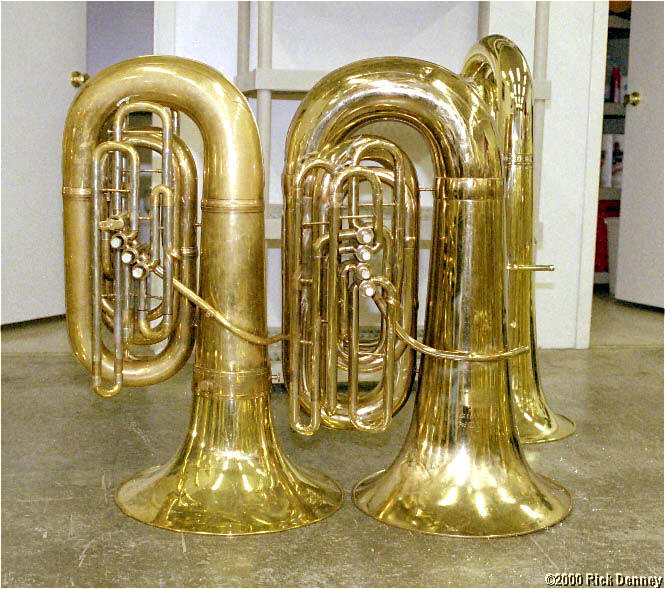
Both have bells of the same size and both have a 3/4" bore. Both are Bb tubas, and both have short leadpipes that put the valves about the same place along the bugle. Yet the Holton is fat with a large throat and relatively little bell flare, while the York Master has narrower branches and a wider bell flare. Both have reasonable intonation, and both sound like tubas. The Holton makes a broader sound with a deeper timbre, but by a smaller margin than one might think. The York Master requires more work to get the size of sound that the Holton produces easily, but it will do it. The Holton requires more work to get an edgy sound, but it will do it.
So, there is some flexibility, and probably all the parts one might find from real tubas would fit within that flexibility range approximately. But that first bit of taper downstream from the valves is not unimportant to intonation. That importance diminishes, probably, closer to the bell, but I'll bet there are exceptions to that.
Rick "unwilling to generalize about compounded nonlinear interactions" Denney
Re: 'Bugle' questions
Posted: Fri Apr 29, 2016 6:41 am
by bububassboner
Rick Denney wrote:Pitch is not about volume more than length, it's still mostly about length.
I have to disagree with this. I've had too many first hand experiences that fly right in the face of this. I'll give a few of them.
First one: I was building a 3+1 compensating monster Eb tuba. I wanted to replace the inner top bow and dog leg with one that tapered slower as the Holton one I had tapered really fast. I found one that would work, but it was quite a bit longer in length. I decided to try and see how flat it would make the horn. Now remember that it played at 440 before the change to the longer bow. Once I installed it and played it the tuba now tuned very nicely to 446. The old bow tapered very fast and got to a large size quickly while the new bow stayed very small for a long time. Because the volume of the longer bow was less it raised the pitch. I had to pretty much double the length of the main tuning slide to compensate for this.
Second one: same tuba. I had an old leadpipe from a B&H Eb that I wanted to use on it. And it played nicely at 440 with about a 3/8 inch pull on the main slide. Well when we bent it it cracked. So since I'm currently not very good at making lead pipes I decided to have Alexander make one for me. They did. Same length but it was from their 173 CC tuba. It started visually a lot larger than the old one. The old used a bass trombone shank while the new use a euro shank. With the new pipe it now plays 10 cents flat with the slide all the way in. Same length, more volume inside the pipe, lowered the pitch.
Third one: in working on this now. I started with a Holton 345 body. I wanted to make a cc tuba but I didn't want to make just another Holton chop job. I decided to use a bell from a Chinese tuba and cut the bottom of the bell to fit the bottom bow. I knew that the shorter bell would also help get the pitch higher without cutting the bows as much. So I got the bell and cut it down. It ended up being just a bit over 6 inches shorter than the original bell. Now remember from BBb to CC is 24 inches. Well after fitting the new bell I rigged it and gave it a toot. I was only 10 cents flat from B. Because cutting six inches from the bell section involved losing a lot more volume than cutting six inches from say the dogleg it made the pitch rise a lot more. Not only did I lose volume from cutting the bell but the throat of the bell was smaller which also helped to raise the pitch.
If I've learned anything from my building studies here in Germany is that any rule that you make is really only a guideline. I remember watching a fellow try some different bells on a CC tuba he was building. They all changed the sound and would move the general pitch up or down but they didn't effect the overtone series accept for one. He tested two York monster Eb bells. One sounded as you would expect but the other had this amazing sound to it. It was the clear winner, until we took the tuner to it. This horn had great intonation but with this one bell the open Gs became 40cents flat across the board. This bell was from what we could tell exactly like the other one. I can't give a good reason for it.
Troy from kanstul and I were talking once about f tubas when they were first making them. He said that over the years on BBb, CC, and Eb tubas they had learned a number of things that they could do to the taper to fix response or pitch issues and they for the most part worked across those keys. But when they started the F tubas all that went out the window. None of those things worked.
Working with and studying with some of the great builders out here has shown me that while they know a lot, there's still a ton we don't know. But the cost to experiment, to try things from scratch is so high that most can't even try. That's why so many horns are similar or based off of another horn. Hell Markus told me that a single bell mandrel for those 6/4 tubas was well over half a million.
We just don't know enough to be able to say a simple equation. If we did all tubas would be awesome and play great. But that lack of knowledge, Thats the fun part in building stuff like I do. I tend to have a good hunch on things, but a lot of times I'm just shocked at the outcome.
Build some more horns. It's fun and you'll learn a lot.
Re: 'Bugle' questions
Posted: Fri Apr 29, 2016 8:04 am
by Rick Denney
bububassboner wrote:Rick Denney wrote:Pitch is not about volume more than length, it's still mostly about length.
I have to disagree with this. I've had too many first hand experiences that fly right in the face of this. I'll give a few of them....
I never said volume didn't matter, nor did I defend simplistic equations. I did say it was more about length than volume. Try this experiment: Widen the bows of a tuba by 25%, and note the change in pitch (there will be some). Now, lengthen the bugle by 25% and note the change in pitch (there will be much more). Of course, lengthening the bugle will have a much greater effect. Thus, it's still more about length.
Rick "who knows the difference between primary and secondary effects" Denney
Re: 'Bugle' questions
Posted: Fri Apr 29, 2016 3:30 pm
by Rick Denney
tuben wrote:
While I know they are not exactly the same thing, when you increase the scale (volume) of a resonator on an organ reed pipe, you must also increase the length of the resonator to accomplish the same pitch.
Sure. There is an effect. But we always have to keep effects in perspective. Tuba myth is replete with examples of small effects given greater emphasis than bigger effects, and we should avoid that. For any given change in volume, the effect on pitch is much less than for the same percentage change in length, and probably by at least an order of magnitude.
For example, I'll bet the bugle length between the York Master and Holton tubas I pictured above differ by single digits of percent, while the diameter varies by double digits of percent (and the volume difference is still greater, given that it varies geometrically with diameter).
Rick "keeping things in perspective" Denney
Re: 'Bugle' questions
Posted: Fri Apr 29, 2016 5:10 pm
by Donn
Rick Denney wrote:tuben wrote:
While I know they are not exactly the same thing, when you increase the scale (volume) of a resonator on an organ reed pipe, you must also increase the length of the resonator to accomplish the same pitch.
Sure. There is an effect. But we always have to keep effects in perspective. Tuba myth is replete with examples of small effects given greater emphasis than bigger effects, and we should avoid that. For any given change in volume, the effect on pitch is much less than for the same percentage change in length, and probably by at least an order of magnitude.
But it's interesting, isn't it, that the difference is in the opposite direction? I mean, I understand bububassboner to be saying length and volume are related in the same way to pitch - so for the same pitch, a longer horn would be narrower and a wider horn would be shorter. (Minus the point in his explanation where he compares trombone & euphonium where I supposed he got turned around.) tuben seems to be saying the opposite for a reed pipe, for the same pitch a longer horn would be wider. I wouldn't doubt both could be true, just goes to show how complicated it can get.
Re: 'Bugle' questions
Posted: Fri Apr 29, 2016 8:30 pm
by Rick Denney
Donn wrote:But it's interesting, isn't it, that the difference is in the opposite direction? I mean, I understand bububassboner to be saying length and volume are related in the same way to pitch - so for the same pitch, a longer horn would be narrower and a wider horn would be shorter. (Minus the point in his explanation where he compares trombone & euphonium where I supposed he got turned around.) tuben seems to be saying the opposite for a reed pipe, for the same pitch a longer horn would be wider. I wouldn't doubt both could be true, just goes to show how complicated it can get.
Most organ pipes are not tapered.
Rick "and that makes all the difference" Denney
Re: 'Bugle' questions
Posted: Sat Apr 30, 2016 8:29 am
by TubaKen
Have to agree with Rick 100%. Sure, some pitches will be affected by volume, but overall pitch is almost completely determined by length. (Pitch = wavelength)