Page 1 of 1
Ways of building tuba bells
Posted: Mon Mar 27, 2017 12:40 am
by bort
I'm familiar with the "normal" way of making tuba bells, which Miraphone shows in their videos:
https://www.youtube.com/watch?v=fRN791nj1rw" target="_blank
As well as the B&S method shown in this video:
https://www.youtube.com/watch?v=WC9nrP7Mr7g" target="_blank
And the traditional style that Alexander uses, with the V-seam.
Willson has this statement on their Website, and this is new to me:
For example, our brass instrument craftsmen are capable of making a one-piece bell out of a circle of metal – something that is immensely important for the famous WILLSON sound.
http://willson.ch/en/content/atelier/production
How does the Willson method work? Are there any photos or videos of this anywhere?
Are there any other methods of building tuba bells?
Re: Ways of building tuba bells
Posted: Mon Mar 27, 2017 9:53 am
by cambrook
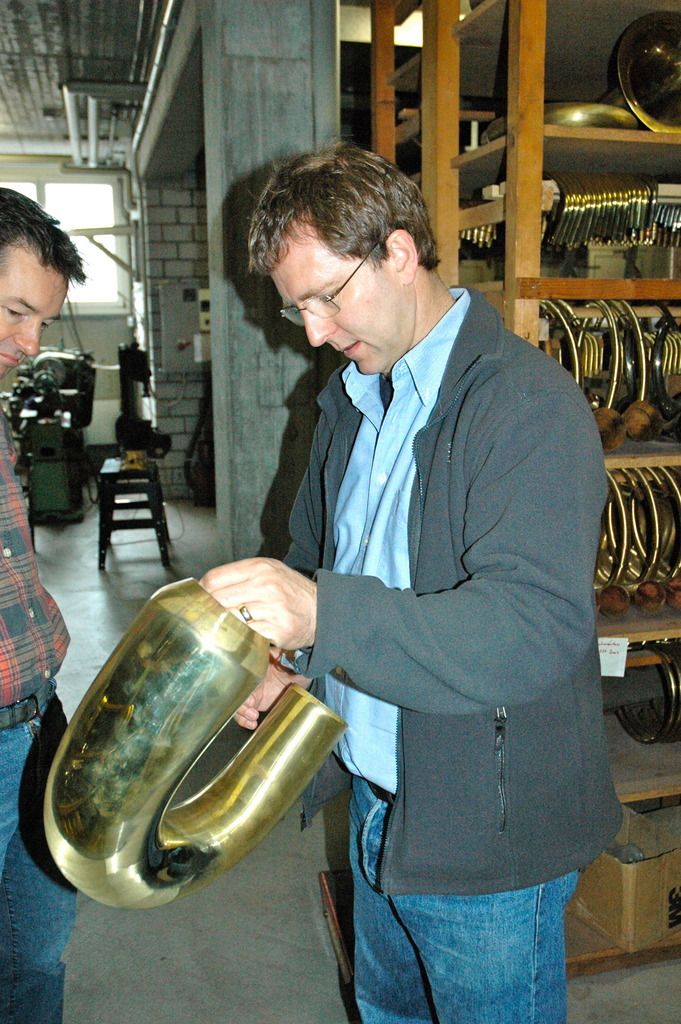
I visited Willson in 2008 - the section that becomes the bell flare is brought to the factory as something resembling a big brass flower pot.
Unfortunately I don't have any photos of the bell making, but this one of hydro-formed bottom bow might give an idea why Willsons are so heavy.
Re: Ways of building tuba bells
Posted: Mon Mar 27, 2017 10:02 am
by Donn
bort wrote:For example, our brass instrument craftsmen are capable of making a one-piece bell out of a circle of metal – something that is immensely important for the famous WILLSON sound.
Mandrel on a lathe?
Trombone bell Likely that would be only the flare part of the bell. It would look a bit like a flower pot - a flat bottom at the snout of the mandrel with a couple holes where it was pinned.
Re: Ways of building tuba bells
Posted: Mon Mar 27, 2017 1:28 pm
by southtubist
I wonder if anyone has tried machining a bell from a solid block of material? Like, one huge block- there would be no seams and the thickness could be kept very uniform.
Perhaps machine out the inside dimensions and then place block over jig/mandrel to provide support before machining the outside dimensions. Might not work for brass (don't know of people buying huge chunks of brass), but it might work for steel or aluminum. I know lathes big enough exist, and it would be an easy process for a CNC machine.
I wonder what a solid machined stainless steel bell would play like? Aluminum, titanium, maybe? Heck, why not depleted uranium!
Re: Ways of building tuba bells
Posted: Mon Mar 27, 2017 1:47 pm
by Three Valves
I don't know about a bell but the DU from one SABOT could probably make a half-dozen mouthpieces!!
Re: Ways of building tuba bells
Posted: Mon Mar 27, 2017 2:03 pm
by tubapix
southtubist wrote:I wonder if anyone has tried machining a bell from a solid block of material? Like, one huge block- there would be no seams and the thickness could be kept very uniform.
Perhaps machine out the inside dimensions and then place block over jig/mandrel to provide support before machining the outside dimensions. Might not work for brass (don't know of people buying huge chunks of brass), but it might work for steel or aluminum. I know lathes big enough exist, and it would be an easy process for a CNC machine.
I wonder what a solid machined stainless steel bell would play like? Aluminum, titanium, maybe? Heck, why not depleted uranium!
Cesium - for that liquid sound

Re: Ways of building tuba bells
Posted: Mon Mar 27, 2017 3:59 pm
by Uncle Markie
Pretty much all tuba bells start out as sheet brass which is then brazed together and finally spun on a mandrel. Hydro-forming was introduced by Conn in the 1930s - that's right, the 1930s. King finally got their hands on hydraulic equipment in the 1970s; prior to that they used clamshell mandrels and cables pulling lead slugs from the big end to the small with hydraulic pistons on large bows. The slugs were then melted down, recast and reused. King did nickel plate their mandrels, which helps account for the consistency of their parts over the years. Once wear was found the tool was spot plated back to spec. Tooling cost a lot of money, especially when it was done by hand without aid of scanners, computers, etc. This method is still used albeit with plastic slugs.
Every brass player should have the opportunity to tour an instrument factory; despite the similarities to other forms of mass production in the end they all jigged up and assembled and soldered by skilled workers - "by hand". The image of kindly old Geppetto tapping away at his workbench disappears quickly when you see how horns are actually produced.
CNC technology has replaced some of the work done by "Swiss screw machines", lathes, etc. Much more consistent and easier to finish off the parts too.
