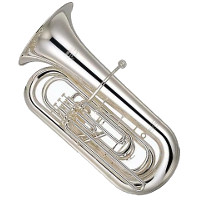
Hard to find any good (or bad) reviews on these.
They sure look stunning. A few youtube clips (might be sponsored)
Some claim build quality is not on par with the cost
I don''t know....Part of me wants one just for the looks
I've heard nothing but good things about these horns and also heard nothing but good things about the overall build quality of all Kanstul instruments.
I've always heard that Kanstul horns sound great up close, and the projection is lackluster. I haven't tried one myself, but this is what I've heard from other people.
I once owned and gigged with a Kanstul trumpet--the build quality was impeccable; right up there among the best that I have ever seen. I'd have no reservations at all about buying a Kanstul tuba.
I own an 80. Never ever had any projection issues.
Nothing but compliments from colleagues.
The horn plays very easy and is very alive.
I can imagine a dead stuffy tuba having projection problems. If you hear a sound coming out then it's projecting.
The real question is whether or not YOU can hear YOURSELF playing this tuba in the type of ensembles you'd like to use such a horn in. This can be very personal.
Intonation is also always something to check out. You can be in love with the sound but if you have to fight with a horn to play in tune you'll probably end up hating yourself for buying it.
I wrote a review on the orchestra grand on one of the Facebook groups after playing a prototype for 2 weeks. I copied and pasted below.
About a month ago some of the tuba players in this group asked me to post my thoughts and a video of the Kanstul Orchestra Grand. I can't post a video however I will post my thoughts. I got to borrow a prototype orchestra grand for 2 weeks. During the last two weeks I also got to play the prototype next to a production model orchestra grand, Martin, York, a Miraphone 1292, a Pt6, and a thor.
I think the Orchestra grand is one of the best tubas on the market. It sounds like a york/martin tuba in modern day form. I own a Martin and have played some yorks. You will not find a modern tuba that has the American tuba sound unless you spend thousands having an old York or Martin torn apart and restored. Kanstul did an amazing job. I played the orchestra grand against a pt6, Miraphone 1292, and a thor and there was no contest. The orchestra has the best sound in my opinion. The orchestra has soo much color and warmth to the tone. I found its German counter parts cold in comparison to sound.
To give some background I talked with Tom Treece and Rob Carpenter the two men responsible for its design. The bottom bow and bell are copies of the one piece bell Martin tubas that the Navy D.C. band used in the 50s but in a smaller size. The York alloy is the same as that of the York metal used in the old York tubas. This is not a copy of the CSO york.
The intonation is spot on but you have to use 1 and 3 for 4th line F and 3rd valve for E and A. A little weird at first but no problems.
The valves are smooth and fast. I really like Kanstul valves since they are made in house along with the rest of the tuba. The 5th valve is unlike any 5th valve I have played. It's a unique design by Kanstul allowing for a full bore 5th valve which allows for a very free blowing 5th valve. The tuba itself is very free blowing and requires the player to be efficient with their air. If you have breathing or air problems this tuba will not work well for you.
The high range is sweet and the low range is very powerful. There is little to no resistance to the low range. You can give the orchestra grand all you got and it will ask for more.
The orchestra grands are made to order and takes about 2 months to make. You can have the tuba customized for you like lead pipe height, thumb ring angle etc. There hasn't been any orchestra grand's on the east coast to try but that is going to change. So check back with the local music shops in the near future. If you are in Florida I can arrange for you to try one.
I had put an order in for a new one with my sons name acid etched into the bell but I had to cancel due to my bad back. The tuba is heavy and not designed for those with bad backs. 7 plus years and counting in the military will do that to you. It really really breaks my heart I can't physically buy one because it has the tuba sound I have been searching for for over 10 years.
As always take what I say with a grain of salt. If you any questions feel free to message me.
This post is primarily about the grand series, but it also about Kanstul in general. I've not played the grand series, but I have 66 Eb. The 33 and 66 are close York copies in metal and design. They capture the American sound, which in my opinion, is more organ like that the German style horns. I really enjoy that sound and think it goes better when playing in an orchestra and band situation. Mine is a bit mouthpiece sensitive, which I think is good. When playing in most situations, I will use a Sellmansberger Symphony. (The Imperial also works rather nicely.) In quintet and solo work, a shallower mouthpiece works best. Mine has a good clear high range and speaks well in the low range. It does take a lot of air in the low range. Fit and finish is on par with the other premium horns out there. So, it really comes down to sound. If you like or want the York American sound, these are the horns you should consider.
I'm surprised that anyone has ever heard anything negative about their quality. I went to the factory about a year and a half ago, and was blown away by their horns. I also really appreciate that everything is made 'in house'. I was/am in love with their travel tubas, but currently have no need for one. I played both of the 5/4 horns they had in the display area, both the BBb and CC lined up really well on my tuner, and were both really comfortable ergonomically for me to hold. It's hard to judge what "projection" means, I find that I don't know too much about how other people hear my sound for a few years of me playing a horn, but I certainly felt like I could push the 2 big Kanstuls as much as I would ever need to.
Great Tuba!! I've had my 5490 CC just over 2 years and have received incredibly positive feedback from conductors & colleagues. One particular conductor mentioned he immediately noticed about 20% more presence than my sound on the PCK, so I'm not quite sure where Bort's "lackluster projection" comments come from...definitely not the case here. It feels quite foreign at first...polar opposite feel & intonation tendencies than the PCK, so it has taken some getting-used-to. Because of this, I was not immediately sold on it, but Roylance's immediate reaction to the sound quality, "WHOA...WOW!!!," convinced me to take the plunge...VERY HAPPY I DID!! I had quite a few modifications, mostly slide length changes & leadpipe raised a few inches. Bob Carpenter requested these become standard, so they possibly are now.
I've often wondered why Kanstul built all his five-valved horns with the extra turns in the 1st and 5th slides. Is this for the intonation? Resistance?
I can't imagine that it's needed just to make everything fit (though I know nothing about this). He doesn't implement this on any of his other instruments as far as I can tell.
pjv wrote:I've often wondered why Kanstul built all his five-valved horns with the extra turns in the 1st and 5th slides. Is this for the intonation? Resistance?
I can't imagine that it's needed just to make everything fit (though I know nothing about this). He doesn't implement this on any of his other instruments as far as I can tell.
A lot of that is due to the fact that Kanstul only makes one valve section for all of their tubas. This section was originally designed for their contra, and works well with all top action instruments. Because all the ports out of the valve section are on one side, this creates a lot of problems when the valve section is mounted for use on a front action tuba.
This is the biggest complaint I have with all Kanstul tubas. I can't even get to a point to comment on how they play because my hand hurts so much after 10 minutes of playing the instrument. Ergonomics just aren't where they should be, in my opinion, and it just makes for a very uncomfortable experience for me.
Sounds plausible. Their 900 on the other hand looks like it doesn't have this issue on the 1st (or am I mistaken?).
I also found it curious that they changed the design on the 33, 66 & 90. I would think (almost) everyone would prefer slanted valves to straight up and down.
Are the valve blocks on most front action tubas angled to the side? I haven't really looked at most of the tubas I have seen with that consideration.
I would have thought with all the front action tubas that they are making, they would have designed a valve block for the front action ones. They went through all the trouble of designing a hollow full-bore rotary valve, so they definitely have the skills on hand.
Yamaha YBB-631S BBb Tuba, B&H Imperial Eb Tuba, Sterling / Perantucci 1065GHS Euphonium
Yamaha YBL-621 RII Bass Trombone and a bunch of other trombones
I just got through looking at the Kanstul tubas, with particular attention to the valve block. The convertible tubas all have three valves, and these are in a straight line. Of the front action 4 valve tubas, only the 902 series has the first three valves in a straight line. All the rest have an angle between each valve. Would that mean that they use a different valve block?
Yeah, I'm a piston valve novice, so I have no idea.
Yamaha YBB-631S BBb Tuba, B&H Imperial Eb Tuba, Sterling / Perantucci 1065GHS Euphonium
Yamaha YBL-621 RII Bass Trombone and a bunch of other trombones
The bore on the "Grand Series" horn is .750. (BBb and CC)
As far as I can tell, they don't make any top action horns with a bore that large.
Knowing that, can we reasonably say that these are top-action valves adapted for front-action?
Yes, all of the tubing exits on the "front" of the valves but that seems to have been a design choice. They could've decided to switch things up when they went to this larger bore but they didn't. Maybe this design allows them to use the same piston in multiple locations? Like 1 & 3 are the same. 2 & 4. It's hard to tell from the photos I can find. Just guessing.
But I think it's safe to say these blocks are "inspired" by top-action valves. : )