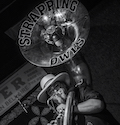
I play into an amp 100+ nights a year and have had to use just about everything under the sun in various backlines... there's a fine art to it and it's always a work in progress.
Tone-wise, I prefer Ampeg the best. End of story... their philosophy (low wattage running high into arrays of 10" speakers) seem to lend themselves really well to the EQ curve of the tuba... which is quite a bit different than the EQ of an e-bass. (Bloke, wanna sell that B-15?!)
I have a couple of varying sizes of Ampegs, but... shlepping and weight are issues. I've also had a couple of GKs. GKs are powerful and built like tanks (even the lightweight ones), but tone-wise (for me) they can get a bit gnarly and finicky. Hartkes are basically "throw away" amps (inexpensive/disposable, which is not a always bad thing, that's why they are commonly backlined) but they can sound relatively decent (the biamp tube/solid head that's common is actually very flexible and decent sounding). I've had good luck with Markbass too, as well as a good ol Hiwatt. Peavy is another inexpensive and built-tough option, but they can be pretty raw sounding (there's a reason thrash bands prefer Peavey bass rigs!)
I like the tuba sound, for most things, to be pretty smooth and warm (and still natural sounding), and then with a limited amount of grit in it should the music warrant it... for when I'm in a bass role.
In general, in my opinion SIMPLE amps tend to sound a bit better (even for softer lighter things) than more boutique-y hi-powered jazz amps... which seem to be much harder to dial in. I strongly think that, in general, since the tuba has a fatter EQ curve (while not as low) than an e-bass, an amp that is basic and plays flat is the way to go...
Keep in mind this... in some ways, the tuba is the OPPOSITE of an electric bass. The basic input EQ of an electric bass is very flat, so the player uses the amp (and various other things) to fatten, expand, and sculpt that EQ.
The tuba on the other hand has a curvier EQ and to get it to be usable to a house PA or just into the room blending with other instruments (while not obscuring them or washing them out; it overlaps with a lot of other instruments) we actually have to flatten the EQ a bit and compress the sound. This is really important. (...which is why amps/setups that make the tone more robust or colorful often are difficult with the tuba)
This all said, about a week ago, I played through one of the little cube Markbass combo amps that has been mentioned a handful of times in this thread. It was awesome and sounded big and warm for it's size. I'm gonna get one. For my small amp, right now I have a little Ampeg PF head and I use a small 210 cab. It's very light, and I love the sound of the head, but I actually liked the Markbass a bit more for a combo... for a small amp setup. I'm sold.
Also... another important caveat is that it depends on the room/PA versus the amount of brain damage the soundperson has sustained.

If the house PA has solid subs, you don't need a huge amp on stage. I've used a tiny 112 GK at a 5000 seat venue and it worked just fine. The amp needs to be big enough for the band (the drummer) to hear/feel your sound, and that's about it.
You need a larger amp for situations where there is not a house subwoofer, naturally. ...and a lot of it of course depends on the type of music. If you are doing cocktail-hour background musical wallpaper gigs, then you need something small with great tone. If you are playing a dance party, then you need something with more oomph to make the rumps bump!
...the amp is part of your tuba sound. (not just something to make it louder)
I will add this (going a bit on a tangent)... because it is a HUGE pet peeve, is the somehow newish trend of soundpeople insisting on taking the bass signal direct into the house via direct box before the amp, so they alone have the control of the bass tone. In medium venues and up, this is the setup 19/20 times... and it can be death for the tuba in my opinion. Insist on that the line to the house be post-amp, that way YOU have the control over the basic tone... simply as *you* know what you want your TUBA to sound like better than the soundperson. You give them the tone you want, and let them adapt it for their room.
Another thing, keep your setups SIMPLE. If there is anything complicated or fancy-looking, such as unfamiliar mic-setups, boutique equipment etc etc, chances are the sound person is just gonna turn you way down to the point of inaudible. Don't give them reason to. They feel like they look like a fool if there is any feedback or issues, and they are more concerned with that than what you actually sound like, so many times, if there is strange stuff, the'll just turn you down to the point of not being heard. (and then they'll say "thats your fault for playing a tuba and not a bass"...)
Much to my back's chagrin, I often schlep an amp simply so that I have the tone I want.
How to adapt the tuba sound into an amplified setup is a really important thing for tuba players!