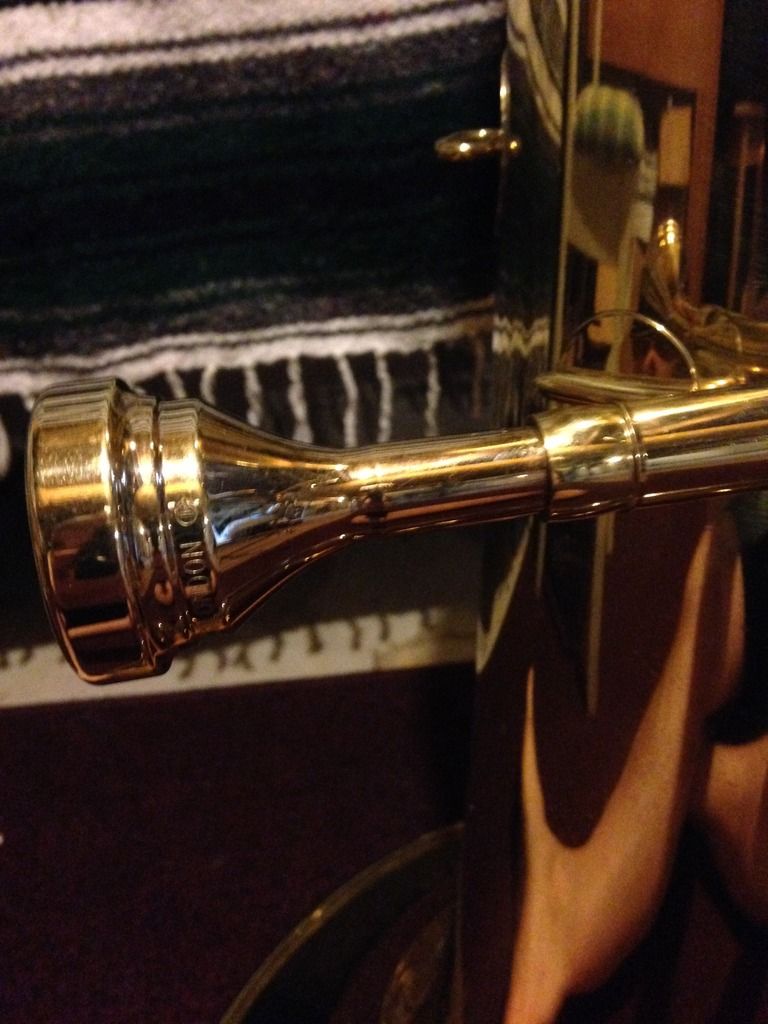
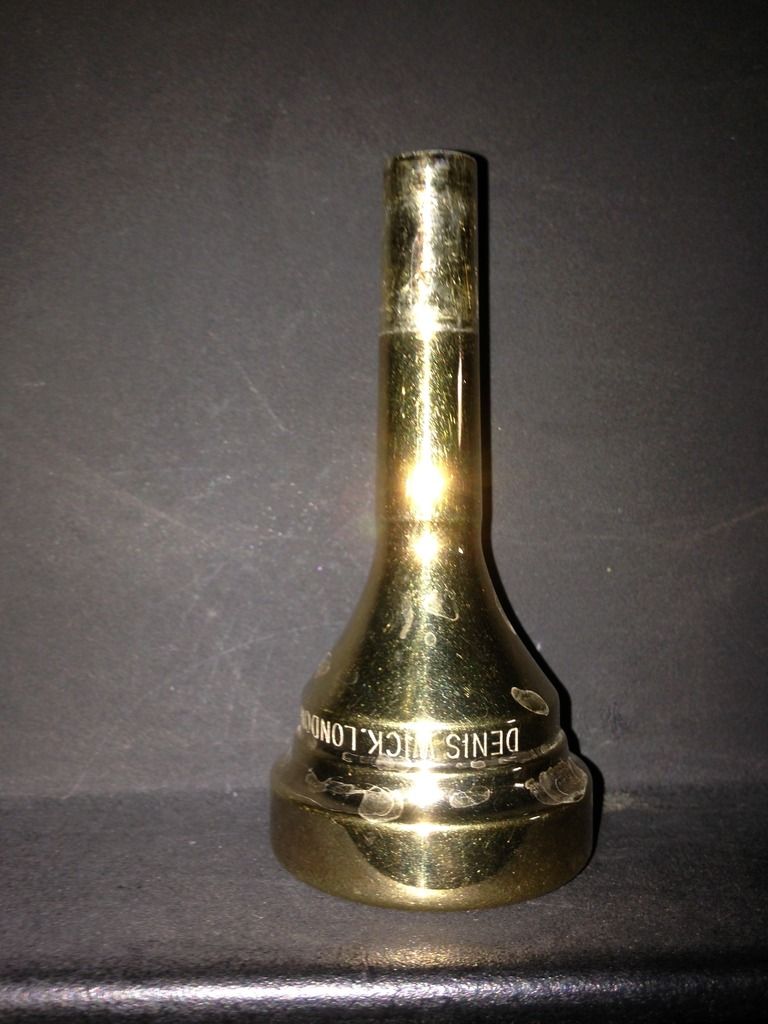


My Wick 3L goes into the German made Besson 982 1", maybe just a tiny bit more with a twist.fsgazda wrote:The mouthpiece goes in 15/16 of an inch. The shank itself is 1 and 15/16" long.
Thanks!


The way I figure it, that difference would push the shank out about 3/8 inch. The present case, it looks to me like we're talking about more like 1/8 inch.MikeW wrote:if it's American Standard it should be about .58", and a Small Euro should be about .56"
That's about right - my Wick 5 is roughly like a large trombone shank. It will fall into your receiver - too small, I'm betting.fsgazda wrote:So just a Wick 3 will fit? I guess I assumed that anything listed as small shank was the old small (bass trombone sized) shank.

The Wessex EEb has a completely different lead pipe and receiver from Jinbaoknarfman wrote:This probably won't help too much because both the horn and mouthpiece are different, but just as a data point I use a Wessex "Solo" compensating EEb with a Wick 3L, but the "Heritage" (bowl-shaped outside) Wick rather than the "Classic" Wick shown in your photos. The shank on my MP goes in 1 & 5/16" (I have two of those mouthpieces and they're consistent). I don't know how much Jonathan has tweaked the receivers on his horns from the original clones (and mine was a demonstrator), but to my eyes your picture looks like the MP isn't going in far enough, as you said originally.
The Bach catalogue lists "Bass Trombone" as .496" at the tip, so it's actually theoretically a tad bigger than the Small Euro Tuba, which is usually quoted as .490"fsgazda wrote:So just a Wick 3 will fit? I guess I assumed that anything listed as small shank was the old small (bass trombone sized) shank.
Thanks for all of the feedback.
Where would you expect to see that choke point in mouthpiece B, in terms of distance from the large end of the receiver?bloke wrote: i.e. Mouthpiece A reaches in toward the choke-point (i.e. actual beginning of the mouthpipe tube) to within 1/32" or 1/16" of the point to where Mouthpiece B reaches, but Tuba A's receiver is short, and doesn't cover up as much of a mouthpiece's shank as does Tuba B's receiver.
Is that your measurement, or more of an assumption? I measured, and I'm saying mine is .530+. I'd love to hear about someone else's measurement.MikeW wrote:The 3L (L for large, according to Wick) is not small shank, it's American Standard, with a tip diameter of .520".



I think I see that, by "as far", you mean relative to the back of the receiver, not the front. We naturally measure the insertion depth from the front, of course, and may not know where the back is (hence the question - without some idea of a normal receiver length, we have no way to distinguish "tuba A" from a small receiver & small leadpipe setup that calls for a smaller shank in order to maintain the prescribed distance to the back end of the receiver.)bloke wrote:and someone could easily mistake that for not being inserted as far
So you have measured it! I feel we're getting close!bloke wrote:"How much of a (reverse-tapered, compared to the expansion that occurs in the entire remainder of the instrument) receiver's interior is left exposed in front of the choke point" (where the mouthpipe tube begins – as far as most are concerned) is the only significant measurement