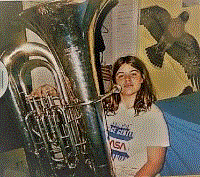
Hi!
What really is the difference between having the 4th valve or not? I always got along fine with 3 valve tubas, and all the fingerings work the same on the 4 valve(or rotary) horns..but you have alternative options like "C" can be 1&3 or 4....but does it really matter? Back in my high-school days I didn't really see a difference but I'm curious to hear the input of experienced tubists.
Also, what are some of the limitations of playing on a 3/4 size tuba? In middle school we played the 3/4 size, which seemed perfectly fine, but I graduated on to full size after a couple years and never went back. My skill level graduated with the size so it's hard for me to recall how they compared head-to-head. I'd imagine it'd be harder to get deeper sound on the smaller size.
Reason behind my questions is that I'm browsing tubas after 14yr of not playing. I'm probably going to be a beginner again, so I'm looking for lower cost options that also won't be too limiting if I relearn quickly.
I appreciate any input or advice for jumping back in on a budget!
Honestly, 3 valves will get you by just fine. If you find that you want an extended lower range or more tuning options, sell that and get a 4 valve horn. The used 3 valved American tubas (Olds, King, and Conn come to mind) usually can be had for a very fair price, and play great. The front action ones will have tuning slides that can be manipulated pretty easily to help with intonation.
I'll respectfully disagree and say that if you are talking about a BBb tuba you should have a minimum of four valves. C and B just below the bass clef staff are used too frequently to try and fight intonation with three valves. Low F, E, Eb and D really need that fourth valve too.
3/4 3v BBb tubas are fine for kiddies in middle school, or for easy strolling gigs. But for more 'involved' music for most adult players in most ensembles, they are limiting. 3/4 tubas 'max out' sound-wise and get really raspy in tone when you push them. The lack of 4th valve means you need to pull slides or set slides to compromise positions for good intonation, as well as missing some 'real' low notes that would otherwise be there on a 4-valver.
Is it realistically possible (I know anything is possible if you hit it hard enough) to add a 5th valve to a 4V front-action piston tuba? I'm picturing a rotary valve left-hand trigger kind of thing. I guess I need to study CC or F tubas more to figure out how this would work out and play.
Follow-up: is it really worth it for a band / orchestra / light solo player (not really any extreme range playing)?
York Master BBb 4V FA tuba Barrington BBb 4V FA tuba York Master Bb 3V FA euphonium Pan American Bb 3V FA euphonium A LeComte & Cie Eb alto "peck" horn York master F French horn Barrington Bb trumpet
Is it realistically possible (I know anything is possible if you hit it hard enough) to add a 5th valve to a 4V front-action piston tuba? I'm picturing a rotary valve left-hand trigger kind of thing. I guess I need to study CC or F tubas more to figure out how this would work out and play.
Follow-up: is it really worth it for a band / orchestra / light solo player (not really any extreme range playing)?
Yes it's possible, but you really need a good tech to do it. Had it done to my Holton Eb 20 years ago; with the 5th valve actuated by the right thumb. The 5th rotor was added after the 4-piston valveset, right before the main tuning slide. For the playing I do on this tuba (mostly quintet) the 5th valve really comes in handy for a lot of music
Obviously, it depends on the situation. 1,000,000 sousaphone players can't be wrong, but they might be wrong in some ensembles. 3 valves is going to work fine for lots of common tuba situations, with no slide pulling. I'd tune 3 so it's right on for 1+3 (and slightly flat for 2+3, sharp for 1+2+3.)
bloke wrote:Though I DO own a 4-valve sousaphone, they are a bit silly.
Same here. A BBb sousaphone that is. Now on Eb, of course, a 4th valve really makes a big difference, if you want to go below A. In which case you'd naturally tune the 4th valve real flat, for that purpose - to work in combination with 1/2/3 for Ab, G etc. And then ... you might as well use that stinker 1 & 3 fingering for F and Bb, if you want something anywhere close to in tune.
As someone who has 6 valves on a Bb tuba I have also played a 3 valve Bb tuba with satisfaction. I think 3 valves will be fine, a fourth valve only immediately fixes 1+3 combinations, which may be sharp without a 4th valve. 4 +2 or 4+2 aren’t going to be in tune without slide pulling, so just keep it simple and stick with 3 valves, if that’s all you need. I think a 4 valve (non compensating) tuba creates as many problems as it solves. Get a tuning drone (insTuner) and learn how to play the 3 valve in tune.
Wow thank you all for the discussion, and the very detailed responses! It sounds like the consensus is that 4 valves & beyond is for those more serious players who can hear the subtle difference to achieve pitch perfection. I honestly didn't even know they made 5 and 6 valves tubas! Do you have to use both hands for fingering? I'd imagine it'd take some carpal contortions to make full use of them.
Also, what are "false tones"?
It sounds like the consensus is that 4 valves & beyond is for those more serious players who can hear the subtle difference to achieve pitch perfection.
IMHO this is a MYTH - don't let it fool you. I am an amateur but markedly improved my pitch by using a tuning drone app ($5) and headphones. I used Instuner and started playing long notes against the drone i could hear via headphones. When the 'wobbles' went away I knew I was playing in tune. As a side not I believe amateur groups could eliminate a lot of intonation issues if they used and could learn from some of these modern tools. Throw away your tuner (kidding - but it teaches your eyes not your ears) and use a drone.
It sounds like the consensus is that 4 valves & beyond is for those more serious players who can hear the subtle difference to achieve pitch perfection. I honestly didn't even know they made 5 and 6 valves tubas! Do you have to use both hands for fingering? I'd imagine it'd take some carpal contortions to make full use of them.
On my 6 valve Bb tuba i use 4 on one hand and two on the other. Once you understand the logic it is quite easy. The tuba i play has very nice short stroke valves, so no finger issues at all. But I only added those valves because I play it in a high level brass band where the parts are written very low and I don't have time to pull slides. But for 95% of situations it would be unnecessary.
But seriously use a tuning drone - you will be amazed at what you soon start to hear
Bellalkaloid wrote:Hi!
What really is the difference between having the 4th valve or not? I always got along fine with 3 valve tubas, and all the fingerings work the same on the 4 valve(or rotary) horns..but you have alternative options like "C" can be 1&3 or 4....but does it really matter? Back in my high-school days I didn't really see a difference but I'm curious to hear the input of experienced tubists.
Also, what are some of the limitations of playing on a 3/4 size tuba? In middle school we played the 3/4 size, which seemed perfectly fine, but I graduated on to full size after a couple years and never went back. My skill level graduated with the size so it's hard for me to recall how they compared head-to-head. I'd imagine it'd be harder to get deeper sound on the smaller size.
Reason behind my questions is that I'm browsing tubas after 14yr of not playing. I'm probably going to be a beginner again, so I'm looking for lower cost options that also won't be too limiting if I relearn quickly.
I appreciate any input or advice for jumping back in on a budget!
My advise on jumping into tuba on a budget - Just pick one of Tom McGrady's BBb tubas (http://www.mackbrass.com) and get yourself back in shape without trying to learn a new key. You could wait and shop for a used instrument - King 2341, Miraphone 186, etc, but you're not going to find a less expensive decent BBb even if it's used. I could post about the virtue of a 4th valve or a 4/4 (or larger tuba), but most of it was said by Elephant or other previous postings in this thread from other actual pro tuba players. For a little bit more $, https://wessex-tubas.com/ tubas might do more (5-valves and such).
Sometimes, I wish I had made the switch to CC and bought one of Tom's CC 410 tubas when I got back into playing, but I didn't know his website existed (it was BRAND NEW when I bought my BBb from Tuba Exchange and I didn't hear about it until later).
Last edited by NCSUSousa on Wed May 29, 2019 12:58 pm, edited 2 times in total.
BBb Tuba with 4 Rotors -
TE-2110 (2009) + TE Rose
Mack 210 (2011) + Bruno Tilz NEA 310 M0
G. Schneider (Made in GDR, 1981?) + Conn Helleberg 120S
I earn my living as an Electrical Engineer - Designing Power systems for buildings
Bellalkaloid wrote:Also, what are some of the limitations of playing on a 3/4 size tuba? In middle school we played the 3/4 size, which seemed perfectly fine, but I graduated on to full size after a couple years and never went back. My skill level graduated with the size so it's hard for me to recall how they compared head-to-head. I'd imagine it'd be harder to get deeper sound on the smaller size.
It sounds like you remember enough. The best thing is to have many tubas, of course, of all different types and sizes, but the standard size is standard for a reason. The size compromise isn't just depth, there's a tonal difference and to some extent volume. I suppose we each have our own tonal tendencies built in, and it's conceivable that some players will sound their very best on a smaller BBb tuba, but I think the reason for those things is more about practical problems of the tuba's size.
Donn wrote:Obviously, it depends on the situation. 1,000,000 sousaphone players can't be wrong, but they might be wrong in some ensembles. 3 valves is going to work fine for lots of common tuba situations, with no slide pulling. I'd tune 3 so it's right on for 1+3 (and slightly flat for 2+3, sharp for 1+2+3.)
This is how 3-valve tubas were tuned as well for concert band. So the excuse that 1+3 is sharp is hot air. Even for trumpet players. Look closely at early Harry James movies and you will see he pulled his trumpet 3rd valve slide and set it so no triggering was necessary. And on my souzy I have the upper loop of the 1st valve circuit converted to a movable slide as well so I can push on 2nd space C and pull for the lower register. And as bloke also observed, on many sousaphones, the privilege tones are perfectly in tune and have good tone from open privilege Eb downwards.
NCSUSousa wrote:
My advise on jumping into tuba on a budget - Just pick one of Tom McGrady's BBb tubas (http://www.mackbrass.com) and get yourself back in shape without trying to learn a new key. You could wait and shop for a used instrument - King 2341, Miraphone 186, etc, but you're not going to find a less expensive decent BBb even if it's used. I could post about the virtue of a 4th valve or a 4/4 (or larger tuba), but most of it was said by Elephant or other previous postings in this thread from other actual pro tuba players. For a little bit more $, http://www.wessex.com tubas might do more (5-valves and such).
Sometimes, I wish I had made the switch to CC and bought one of Tom's CC 410 tubas when I got back into playing, but I didn't know his website existed (it was BRAND NEW when I bought my BBb from Tuba Exchange and I didn't hear about it until later).
Thank you SO MUCH these links. I took a look and I think I'm already in love with some of these... I was really clueless about what was out there, hesitant to spend grands on a used horn without even knowing what I would be getting, or how it'd work. I nearly bought a plastic cool wind for $1200, but just couldn't do it.
Watching demo videos, those CC tubas really do sound amazing, especially in the low notes. I hear their fingerings are completely different though, and it's like "learning a new language"... would you say this is true?
NCSUSousa wrote:
My advise on jumping into tuba on a budget - Just pick one of Tom McGrady's BBb tubas (http://www.mackbrass.com) and get yourself back in shape without trying to learn a new key. You could wait and shop for a used instrument - King 2341, Miraphone 186, etc, but you're not going to find a less expensive decent BBb even if it's used. I could post about the virtue of a 4th valve or a 4/4 (or larger tuba), but most of it was said by Elephant or other previous postings in this thread from other actual pro tuba players. For a little bit more $, http://www.wessex.com tubas might do more (5-valves and such).
Sometimes, I wish I had made the switch to CC and bought one of Tom's CC 410 tubas when I got back into playing, but I didn't know his website existed (it was BRAND NEW when I bought my BBb from Tuba Exchange and I didn't hear about it until later).
Thank you SO MUCH these links. I took a look and I think I'm already in love with some of these... I was really clueless about what was out there, hesitant to spend grands on a used horn without even knowing what I would be getting, or how it'd work. I nearly bought a plastic cool wind for $1200, but just couldn't do it.
Watching demo videos, those CC tubas really do sound amazing, especially in the low notes. I hear their fingerings are completely different though, and it's like "learning a new language"... would you say this is true?
I never made the jump to CC, but I figure it would have been easier to do it right away when I got back to playing. Everything I've read here suggests that the 410CC tuba is good.
For the past few weeks, I've been borrowing my dad's Mack 210 BBb while he's recovering from shoulder surgery. It's significantly a better instrument than my TE-2110. I might sell my TE-2110 and call Tom or Jonathan to get something else this summer. I know my dad will want his tuba back when he's approved by the docs to pick it up again.
Edit - I just realized I didn't put the right link for wessex tubas in my original post - https://wessex-tubas.com/
BBb Tuba with 4 Rotors -
TE-2110 (2009) + TE Rose
Mack 210 (2011) + Bruno Tilz NEA 310 M0
G. Schneider (Made in GDR, 1981?) + Conn Helleberg 120S
I earn my living as an Electrical Engineer - Designing Power systems for buildings
@ Bloke regarding use of sousas in school band. My high school in the 1990s did that as well -- we used our King sousas for both marching and concert band, and they sounded great in the auditorium. I think sousaphones have an advantage over comparable tubas for such ensembles for the false tones and the more diffuse sound, which works well for large ensembles where the tubas (sousas) ARE "the basses".
Also, every BBb sousaphone I've played has good or very good overall intonation that is malleable due to the response characteristics of sousas
bloke wrote:Wandering off-topic, I'll go one further...
Those rolling their eyes were not around when our section of four (fiberglass) 36K sousaphones was in action...and did not consistently have the "floor wiped with" the not-coached-by-anyone operators of those sousaphones in auditions for chairs in regional and statewide events - year-in and year-out.
I love my 36K Fiberglass sousaphone. I can play just as loud as the other Tuba players in our Fire Department Band playing on metal horns that weigh a good 15 pounds more. My intonation and tone are just as good as theirs are as well. It would be a great all around horn for a Middle or High School on a budget. I really don't see why Fiberglass Sousaphones get such negative reactions.
Retired Army Reserve 98th Div. Band: Euphonium, Trombone, Tuba, Bass Guitar
Miraphone 186 CC
Conn 36K Sousaphone
Euphonium: Yamaha YEP-321 (modified with Euro-shank receiver with Lehman M mouthpiece)
Trombones:Yamaha 612 Bass, Conn 88H