The Alexander tuba sound is one of the most influential sounds from any manufacturer of tubas. My concept of sound began with my first tuba teacher in 1972, Harold Strand, who played an Alexander tuba in the Phoenix Symphony for 24 years. In January of 1980, I had the great fortune of studying with Michael Lind. Harvey Phillips went on sabbatical and Michael Lind became my teacher for the semester. If you haven’t heard this great virtuoso, you can find him on Youtube. Michael Lind is playing an Alexander F tuba. When I started learning F tuba, I played an Alexander owned by Indiana University. It wasn’t until early 1992 that I bought my first Alexander tuba – a rare, solid nickel silver five-valve 163. Around 2011, I bought one of Mike Thornton’s Alexander tubas, another five-valve brass 163. In 2012 I bought a six-valve F tuba – sold that in 2015 for a five-valve F tuba owned for 44 years by Kevin Ladd.
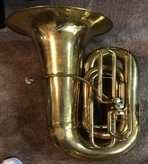
This past St. Patrick’s Day, I gave this forum a look while eating lunch. A rare 164 model in C was for sale. Three days later I received the horn for trial. The 164 is the “Kaiser” model – it’s big, as you can see from the photo. In my entire life, I’ve never played this model Alexander. The only one I’ve ever seen was when I visited the Alexander factory in September of 2011. It was in the workshop on a table being built. My trip the Alexander factory is documented in an article I wrote for the ITEA Journal – Winter 2012 – entitled, Sound Legacy.
The “lore” of Alexander tubas is – great sound, bad intonation – especially with the 164. Having never played this model, I wanted to find out for myself what this model was about – rather than rely on what’s been passed down by those who have most likely never played this model tuba. When I sat down to give it a toot, my wife was home – and there is not another set of ears I trust more than my wife’s! Three or so notes came out and her immediate response was: “Wow!” The last new (to me) tuba I played for her, she said: “sounds like you.” Not quite the same first reaction. For the past two weeks, having to stay at home, I’ve spent many hours each day learning about what this tuba can do. Quite simply, it’s a magnified 163 – more air, more sound, and more volume.
Much of my time these past two weeks has been addressing the pitch issues of this tuba. What I discovered is many of the issues were coming from the first valve slide – it was too long. On my c.1980 brass Alexander, the first valve slide was cut, along with the tuning slide. On both of my 163’s, intonation is not a problem at all and the brass Alex may be better by about one note. This past Friday afternoon, I cut an inch off the first valve slide. Yes, rather radical, but it immediately improved about a dozen notes, because now I have the freedom to push the first slide in. The cross brace had to be removed as it was too tight for the slide to move freely. The surgery was a success! Now there is only one note I need to resolve, and I think it’s more me than the tuba. Note: The slide in the photo is not yet cut.
This tuba was built in 2003 and it’s been played very little – it’s in amazing condition. The response in the very low end is the best I’ve ever experienced. The room I practice in at home is our office and guestroom – it’s too small for the amount of sound this instrument can produce. Each and every day I spend on this instrument, the better it becomes. At some point, my orchestra will be back at work and I can see what it does in our hall.
My point in writing about this tuba is simply – stay open – about everything in life! Find out for yourself. Had I listened to others; I may not have explored owning this tuba. Not only do we do this with “stuff”, we do this with people as well. We don’t have to agree with everyone about everything. We don’t have to play equipment that everyone else is playing to be accepted. Find your own path. Better yet, bushwhack where no one else has gone before!
Alexander Lore
-
Ted Cox
- pro musician

- Posts: 130
- Joined: Tue Mar 30, 2004 9:38 am
- Location: Oklahoma City
- Contact:
Alexander Lore
You do not have the required permissions to view the files attached to this post.
Last edited by Ted Cox on Sun Apr 12, 2020 8:18 am, edited 1 time in total.
-
cjk

- 5 valves

- Posts: 1915
- Joined: Fri Mar 19, 2004 12:16 pm
Re: Alexander Lore
I rather like reading your thoughtful posts. Could you posibly post a picture of the 5/4 Rudolf Meinl CC you have for sale next to the Alexander 164 just for a size reference?
-
bort

- 6 valves

- Posts: 11224
- Joined: Wed Sep 22, 2004 11:08 pm
- Location: Minneapolis, Minnesota
Re: Alexander Lore
Congratulations!
So that 164 very, very nearly ended up with me in Minneapolis about a month or two ago. Plus, about 3 times before that in the past few years, I almost bought it. Usually came down to money, and I was always very curious about it. It's very rare, and they have only ever made a few Kaiser tubas in CC, as far as I know.
This tuba you own, I've heard many opinions from people. Seemed that most everyone likes the sound. One highest level professional said "woof" and didn't like much at all about it. And a few amateur players said they found it hard to play well in tune, that nothing lined up. The seller you bought it from gave me a very honest assessment of it, and I was not concerned about the tuba based on it. This all led me to believe that Is just have to try it for myself. If some people like it and others don't... Well, that's not telling me a whole lot!
But much like the Rudy 5/4 youre selling, the 164 is a professional tuba that requires a strong player, practice, and player maintenance. The work will be rewarded. Maybe it's not even so much work, as much as building and keeping familiarity.
Ben Vokits in NYC also owns an Alex 164 CC, which has previously owned by JC Sherman. That's a great sounding tuba, and a bit of a beast to play for the uninitiated. It just needs different fingering patterns. Get used to that, and you will be just fine.
A few weeks ago, I finally got to buy an Alexander 163 (I turned down buying the 164 to get this 163 instead). I've owned many tubas before, and have tried a few Alexander's along the way. This 163 is a special tuba, and blows everything out of the water for me, just fantastic. It also has an interesting history, both with it's previous owner and in some of the modifications done to it. But it is outstanding, and a keeper for me. And I never keep anything, haha!
BTW, also cool that you have Kevin's Alex F. 10+ years ago, I had the pleasure of playing alongside him in some bands in Baltimore. He told me about that F tuba, and (I believe) that it was so important to him because his parents worked hard to buy it for him when he was young (jeez I hope I'm remembering that correctly). I remember when he sold it through BBC, being surprised to see that. But, like, and tubas, go on. I bought his backup Marzan tuba about 10 years ago, which was a cool tuba. His primary horn, also a Marzan CC, was exceptional. Of course, he's just an exceptional player, so that has everything to do with it too.
I haven't talked to Kevin in many years. He was teaching public school in the Baltimore area. I hope he is doing well!
So that 164 very, very nearly ended up with me in Minneapolis about a month or two ago. Plus, about 3 times before that in the past few years, I almost bought it. Usually came down to money, and I was always very curious about it. It's very rare, and they have only ever made a few Kaiser tubas in CC, as far as I know.
This tuba you own, I've heard many opinions from people. Seemed that most everyone likes the sound. One highest level professional said "woof" and didn't like much at all about it. And a few amateur players said they found it hard to play well in tune, that nothing lined up. The seller you bought it from gave me a very honest assessment of it, and I was not concerned about the tuba based on it. This all led me to believe that Is just have to try it for myself. If some people like it and others don't... Well, that's not telling me a whole lot!
But much like the Rudy 5/4 youre selling, the 164 is a professional tuba that requires a strong player, practice, and player maintenance. The work will be rewarded. Maybe it's not even so much work, as much as building and keeping familiarity.
Ben Vokits in NYC also owns an Alex 164 CC, which has previously owned by JC Sherman. That's a great sounding tuba, and a bit of a beast to play for the uninitiated. It just needs different fingering patterns. Get used to that, and you will be just fine.
A few weeks ago, I finally got to buy an Alexander 163 (I turned down buying the 164 to get this 163 instead). I've owned many tubas before, and have tried a few Alexander's along the way. This 163 is a special tuba, and blows everything out of the water for me, just fantastic. It also has an interesting history, both with it's previous owner and in some of the modifications done to it. But it is outstanding, and a keeper for me. And I never keep anything, haha!
BTW, also cool that you have Kevin's Alex F. 10+ years ago, I had the pleasure of playing alongside him in some bands in Baltimore. He told me about that F tuba, and (I believe) that it was so important to him because his parents worked hard to buy it for him when he was young (jeez I hope I'm remembering that correctly). I remember when he sold it through BBC, being surprised to see that. But, like, and tubas, go on. I bought his backup Marzan tuba about 10 years ago, which was a cool tuba. His primary horn, also a Marzan CC, was exceptional. Of course, he's just an exceptional player, so that has everything to do with it too.
I haven't talked to Kevin in many years. He was teaching public school in the Baltimore area. I hope he is doing well!
-
Ted Cox
- pro musician
- Posts: 130
- Joined: Tue Mar 30, 2004 9:38 am
- Location: Oklahoma City
- Contact:
Re: Alexander Lore
When I bought my nickel 163 in 92, it took a minute to find where the tuba played. I switched from a Miraphone 186 I owned for 17 years. Remembering that experience was/is important with this 164. Also, the Rudy is a tad bigger in bore size, but one couldn't tell playing the 164. If you never picked up an Alex in your life - and you've never played something as big as the Rudy 5/4, anyone would be lost for a while with the 164. I feel I have an advantage over most people having played a 163 for 28 years and a the Rudy for 18 months. It's coming together rather quickly. My target is next season beginning in September, so I have some time to settle in. Our principal bassoonist bought a 1920's Heckel he found. He had it restored and then played it for a full year before bringing it to work. Some instruments take time - we seem to be too impatient these days - we want it now!
I bought Kevin's F unplayed and unseen. Anyone who owns an instrument for 44 years must really like it. It's a solid Alex F from 1960. Kevin was actually the second owner.
I bought Kevin's F unplayed and unseen. Anyone who owns an instrument for 44 years must really like it. It's a solid Alex F from 1960. Kevin was actually the second owner.
-
bisontuba

- 6 valves
- Posts: 4323
- Joined: Sat Mar 20, 2004 8:55 am
- Location: Bottom of Lake Erie
-
EMC
- 4 valves

- Posts: 643
- Joined: Thu Sep 12, 2013 1:54 am
Re: Alexander Lore
Are both Alex 163s in CC? Ive owned three Alexs in my time a BBb 164 a CC 163 and an old alex tuba that was originally a 4 valve F and I added a 5th and I sold them all but if hadnt needed to i wouldnt of. Ive never heard of a solid nickel silver tuba though, what are the playing characteristics of that horn? Is it one with a flat 23 ? mine was and ive always preferred that set up.
-
Ted Cox
- pro musician
- Posts: 130
- Joined: Tue Mar 30, 2004 9:38 am
- Location: Oklahoma City
- Contact:
Re: Alexander Lore
Both 163's are in CC. The fifth valve on my nickel horn is a flat half step. The fifth valve on the brass 163 is two whole steps. The fifth valve on the 164 is a flat whole step. If you think one is better than the other - you haven't played all three variations. On the nickel horn, I have to play low Db as a false tone, two and three, as low D is all five.
The nickel tubas are RARE - only about five or six ever made by Alexander. I've personally seen another CC - rough shape. Michael Lind had a nickel F in 1984. Connie Weldon played a nickel 164, to my understanding. Anton Alexander said he had to bring gifts to the men building the instruments as a sort of bribe. Nickel silver is not easy to work with. Overall, nickel silver responds a bit slower, but you can push it like crazy and not have the sound change. It also makes a unique sound - a brass Alex on steroids, if you will. My horn is circa 1963. I know this because my first teacher had a student who bought this tuba - for $495, with hard case (which I still have). I've attached a photo - all clean and shiny.
The nickel tubas are RARE - only about five or six ever made by Alexander. I've personally seen another CC - rough shape. Michael Lind had a nickel F in 1984. Connie Weldon played a nickel 164, to my understanding. Anton Alexander said he had to bring gifts to the men building the instruments as a sort of bribe. Nickel silver is not easy to work with. Overall, nickel silver responds a bit slower, but you can push it like crazy and not have the sound change. It also makes a unique sound - a brass Alex on steroids, if you will. My horn is circa 1963. I know this because my first teacher had a student who bought this tuba - for $495, with hard case (which I still have). I've attached a photo - all clean and shiny.
You do not have the required permissions to view the files attached to this post.
-
olaness1
- bugler

- Posts: 88
- Joined: Sat Apr 22, 2017 5:18 am
Re: Alexander Lore
Wow, that's one cool instrument. I have heard that the nickel instruments are also an absolute pig to repair if you need anything done that means bending metal.
I've also found that my Alexes (I have three, F, Eb and a gold brass 163 Bb that once upon a time belonged to John Fletcher) are very sensitive to mouthpieces. My Bb refuses to cooperate with anything Helleberg-ish, needs a bowl shaped mouthpiece, whilst the F changes tuning characteristics completely with any new gob iron that gets put in there.
I've also found that my Alexes (I have three, F, Eb and a gold brass 163 Bb that once upon a time belonged to John Fletcher) are very sensitive to mouthpieces. My Bb refuses to cooperate with anything Helleberg-ish, needs a bowl shaped mouthpiece, whilst the F changes tuning characteristics completely with any new gob iron that gets put in there.
-
bort
- 6 valves
- Posts: 11224
- Joined: Wed Sep 22, 2004 11:08 pm
- Location: Minneapolis, Minnesota
Re: Alexander Lore
On my 163, when I use a Rudy Meinl RM1, everything lines up very nicely, with zero complaints. Just 12 and 23 for E and Eb in the staff (like most CC tubas), and the usual 4-valve CC low register fingerings.
When I use my Thein RCC (my go-to for the last several years), the sound is bigger... but the intonation is different. I'm not saying it's bad... because it's not... it's just different. This is also an Euro shank mouthpiece, and my tuba was refitted with a standard receiver. I know... not always a huge difference there... but for an instrument that may already be mouthpiece sensitive, that could be a factor, although likely far outweighed by the size difference in mouthpieces (the RCC is bigger than the RM1).
When I use my Thein RCC (my go-to for the last several years), the sound is bigger... but the intonation is different. I'm not saying it's bad... because it's not... it's just different. This is also an Euro shank mouthpiece, and my tuba was refitted with a standard receiver. I know... not always a huge difference there... but for an instrument that may already be mouthpiece sensitive, that could be a factor, although likely far outweighed by the size difference in mouthpieces (the RCC is bigger than the RM1).
-
Ted Cox
- pro musician
- Posts: 130
- Joined: Tue Mar 30, 2004 9:38 am
- Location: Oklahoma City
- Contact:
Re: Alexander Lore
As I understand it, the Shilke Helleberg 2 was designed by Rex Martin and Scott Laskey specifically for Rex's Rudy 5/4. Owning a Rudy 5/4, it made sense to check it out. For the past year, that's the mouthpiece I use 100% of the time. For me, it works great on my Alex's - but I'm sure there are other mouthpieces that work equally great. That's a merry-go-round I'd rather not ride. Too pricey!
-
bigboymusic
- 3 valves

- Posts: 383
- Joined: Fri Mar 19, 2004 7:54 am
- Location: Independence, MO
Re: Alexander Lore
I owned one of the Nickel Alex 163's for about three years 2002-2005. I love the sound I get on an Alex as well, but as much as I didn't want to sell the horn, it just never really sounded like 'me'. Addressing the repairs... The horn I had the factory estimated 1960ish, and in 2002 when I bouhgt it. NO DENTS. And I'm not surprised. I could have jumped up and down on this bell and bows, and I would have been injured. It was heavy and solid. It also came with a tuning loop for Bflat and the horn played equally in tune with the loop until you hit the top of the staff.
Ivan Hammond was the man who pushed me to the Alex side. His main horn at that time was an HB2P, but his F was an Alex and he always seemed to have a couple CC's laying around.
Ivan Hammond was the man who pushed me to the Alex side. His main horn at that time was an HB2P, but his F was an Alex and he always seemed to have a couple CC's laying around.
Paul Weissenborn
St. Joseph Symphony Orchestra (MO)
Spirit of Independence Band
SJSO Quintet
Alex 163 CC
YEB 321S
St. Joseph Symphony Orchestra (MO)
Spirit of Independence Band
SJSO Quintet
Alex 163 CC
YEB 321S
-
EMC
- 4 valves
- Posts: 643
- Joined: Thu Sep 12, 2013 1:54 am
Re: Alexander Lore
Thats all really awesome info, Ive played horns with flat half steps obviously, and the one with the two steps 5th valve but never heard of a flat half step 5th valve, also didnt mean to imply one was better than the other just that the 2 whole steps is my preference. Id love to some day own a nickel alexander someday but id probably be lucky to ever even see one if theres only 5 or 6, thats insane! a nickel alexander 164 sounds like an amazing tuba, the yellow brass 164 BBb i used to own had a absolute godly sound.Ted Cox wrote:Both 163's are in CC. The fifth valve on my nickel horn is a flat half step. The fifth valve on the brass 163 is two whole steps. The fifth valve on the 164 is a flat whole step. If you think one is better than the other - you haven't played all three variations. On the nickel horn, I have to play low Db as a false tone, two and three, as low D is all five.
The nickel tubas are RARE - only about five or six ever made by Alexander. I've personally seen another CC - rough shape. Michael Lind had a nickel F in 1984. Connie Weldon played a nickel 164, to my understanding. Anton Alexander said he had to bring gifts to the men building the instruments as a sort of bribe. Nickel silver is not easy to work with. Overall, nickel silver responds a bit slower, but you can push it like crazy and not have the sound change. It also makes a unique sound - a brass Alex on steroids, if you will. My horn is circa 1963. I know this because my first teacher had a student who bought this tuba - for $495, with hard case (which I still have). I've attached a photo - all clean and shiny.
-
Ted Cox
- pro musician
- Posts: 130
- Joined: Tue Mar 30, 2004 9:38 am
- Location: Oklahoma City
- Contact:
Re: Alexander Lore
Just to be clear. My nickel Alex is a 163, not a 164.
When I took the nickel Alex to Germany in 2011, Philip Alexander had never seen one. Very rare!
While I'm here - I've attached a photo of the completed shortening of the first valve slide on the 164. It turned out quite well - having never taken a saw to a tuba before. I recycled one of the braces and put it between the 5th valve sleeve and the first valve. This surgery wasn't hard to do at all - just take a big breath and take your time. Your tuba might also benefit from a shorter slide. If you're considering this, I'll be happy to give you some more details. My email is ted@spirithouseyoga.com" target="_blank" target="_blank" target="_blank" target="_blank" target="_blank" target="_blank" target="_blank
When I took the nickel Alex to Germany in 2011, Philip Alexander had never seen one. Very rare!
While I'm here - I've attached a photo of the completed shortening of the first valve slide on the 164. It turned out quite well - having never taken a saw to a tuba before. I recycled one of the braces and put it between the 5th valve sleeve and the first valve. This surgery wasn't hard to do at all - just take a big breath and take your time. Your tuba might also benefit from a shorter slide. If you're considering this, I'll be happy to give you some more details. My email is ted@spirithouseyoga.com" target="_blank" target="_blank" target="_blank" target="_blank" target="_blank" target="_blank" target="_blank
You do not have the required permissions to view the files attached to this post.
-
Heavy_Metal
- 5 valves
- Posts: 1739
- Joined: Fri Jul 20, 2012 10:42 pm
- Location: Baltimore, MD, USA
Re: Alexander Lore
That was my reaction when I first tried the ancient Alex BBb I now own. Even with leaky valves (since repaired) it still had the Alexander sound, so I pounced.Ted Cox wrote:Three or so notes came out and her immediate response was: “Wow!”
Mark Chachich originally turned me on to the Alex sound many years ago, when he first got his 163CC. Now that I have mine, when he and I play together, it's hard to tell where his sound ends and mine begins. "Where two or more Alexanders are gathered together".............
Principal tuba, Bel Air Community Band
Old (early 1900s?) Alexander BBb proto-163
1976 Sonora (B&S 101) 4-rotor BBb
~1904 York 3P BBb Helicon
Old Alex Comp.F, in shop
Old (early 1900s?) Alexander BBb proto-163
1976 Sonora (B&S 101) 4-rotor BBb
~1904 York 3P BBb Helicon
Old Alex Comp.F, in shop
-
MackBrass
- TubeNet Sponsor

- Posts: 862
- Joined: Fri Apr 09, 2004 7:22 am
- Location: Virginia
- Contact:
Re: Alexander Lore
I honestly cant remember how many Alex 163 CC tubas I have owned in the past but the one I currently have is the 2nd best I have ever owned. The best I have ever owned I sold to Mark Barton in the Houston area. Unfortunately when I called Mark to see if he was interested in selling it, he informed me that it was stolen out of his office. At the time I was willing to pay a lot to get it back.
About 8 years ago I took in on trade another Alex but almost didnt go through with it because the horn was about 20 cents flat across the board. After cutting about 2 inches from the leadpipe i was now in the ballpark. Since the horn had a very manageable open G below the staff and no alternative fingerings were needed I decided time to add a 5th valve, something i have done to most of the Alex CC. But instead of going with a standard Alex design, I went with a B&S F tuba inspired design. The 5th is a .750 bore and the leadpipe was actually meant for a Mack210.
Here is the final mock up of the horn where I was testing it at a local college I was teaching at.
https://m.youtube.com/watch?v=03guqi1Tf1w" target="_blank
After working on it I had to record a few things to make sure my ears weren't playing tricks on me as it was very in tune. I literally just had the leadpipe and 5th valve tacked in place in case it didnt work out. By adding a smaller leadpipe, and when I say smaller, there was no comparison. To me there is no comparison between this and any other I have played or owned. I am at a point that if I have use any alt fingerings I just put the horn down.
About 8 years ago I took in on trade another Alex but almost didnt go through with it because the horn was about 20 cents flat across the board. After cutting about 2 inches from the leadpipe i was now in the ballpark. Since the horn had a very manageable open G below the staff and no alternative fingerings were needed I decided time to add a 5th valve, something i have done to most of the Alex CC. But instead of going with a standard Alex design, I went with a B&S F tuba inspired design. The 5th is a .750 bore and the leadpipe was actually meant for a Mack210.
Here is the final mock up of the horn where I was testing it at a local college I was teaching at.
https://m.youtube.com/watch?v=03guqi1Tf1w" target="_blank
After working on it I had to record a few things to make sure my ears weren't playing tricks on me as it was very in tune. I literally just had the leadpipe and 5th valve tacked in place in case it didnt work out. By adding a smaller leadpipe, and when I say smaller, there was no comparison. To me there is no comparison between this and any other I have played or owned. I am at a point that if I have use any alt fingerings I just put the horn down.
-
bort
- 6 valves
- Posts: 11224
- Joined: Wed Sep 22, 2004 11:08 pm
- Location: Minneapolis, Minnesota
Re: Alexander Lore
Can I ask a few random Alex questions here:
* Has the width of the Kranz changed of the years? My Kranz is about 1", and looks like the new-style Miraphone kranz, instead of the thicker (2"?) style. Is that an indication of age? I've heard that this isn't the original bell for my Alexander, so that's why I'm curious.
* Are Alexander bells always made with the gusset ("V") method? My bell is silver plated, so I can't see the seams.
* Are the bottom valve caps engraved? I've seen that on brand new Alex tubas, but my valve caps are smooth and shiny.
* My tuba has an extra "guard" on the bottom of the 4th valve tubing. Which seems really smart, since that part of the back of the tuba is a dent magnet on many horns. Stock, depends on age, or aftermarket?
* Did the ferrules change over the years?
* No serial numbers (at least before a certain time), right?
* Has the width of the Kranz changed of the years? My Kranz is about 1", and looks like the new-style Miraphone kranz, instead of the thicker (2"?) style. Is that an indication of age? I've heard that this isn't the original bell for my Alexander, so that's why I'm curious.
* Are Alexander bells always made with the gusset ("V") method? My bell is silver plated, so I can't see the seams.
* Are the bottom valve caps engraved? I've seen that on brand new Alex tubas, but my valve caps are smooth and shiny.
* My tuba has an extra "guard" on the bottom of the 4th valve tubing. Which seems really smart, since that part of the back of the tuba is a dent magnet on many horns. Stock, depends on age, or aftermarket?
* Did the ferrules change over the years?
* No serial numbers (at least before a certain time), right?
-
WessCollette
- bugler
- Posts: 49
- Joined: Mon Jul 30, 2018 9:05 am
- Location: Summerville, GA
Re: Alexander Lore
One of my college tuba teachers, Randall Foil, lived Alexander's. He priced one to me at the time, which was a decent price, but being a broke college student with no parent backing, I had to decline. This thread makes me wish I had worked harder to get that one.
-
pjv

- 4 valves
- Posts: 879
- Joined: Sun Jul 11, 2004 4:39 am
Re: Alexander Lore
About your nickel silver horn; is that 100% through and through?
I'm asking because I also have a 163 (BBb) nickel silver Alex but that's on top of red brass. I can see the red brass underneath at places where the nickel has worn off.
I bought the tuba in the Netherlands. Apperently the Dutch often ordered their tuba's from Alex in nickel silver for their wind bands.
I'm asking because I also have a 163 (BBb) nickel silver Alex but that's on top of red brass. I can see the red brass underneath at places where the nickel has worn off.
I bought the tuba in the Netherlands. Apperently the Dutch often ordered their tuba's from Alex in nickel silver for their wind bands.
-
Rick Denney

- Resident Genius
- Posts: 6650
- Joined: Mon Mar 22, 2004 1:18 am
- Contact:
Re: Alexander Lore
Back in the deeps of time, I studied with Mike Sanders for a bit while he was in San Antonio. He famously played an Alex 163 with four valves, and the sound he made with it was one reason I was so pleased he would give me some lessons. The sound was thrilling--powerful, commanding, direct, even brooding at times. It always sounded as though it was coming from the stage, but there was no orchestral tutti it couldn't punch through, without losing that characteristic column of sound.
Then, he bought his Yorkbrunner, and I was stunned by the difference. The Yorkbrunner was present--and it had to work at it to achieve that--my seats were on the back row of the mezzanine. The hall was large (3000 seats) and it gave the impression that Mike was sitting next to me in a small room. It also had a happy character that made me smile (I can think of no other way to say it). The Alex inspired awe, and the Yorkbrunner made me smile. Eventually, he sold the Alex to Morris Kainuma of the Honolulu Symphony. This was all back in the early-to-mid 80's.
In my lessons with him, he demonstrated his points using the Alex, and I think hearing that sound up close was as valuable as anything I learned in those lessons (not that I've been able to attain even a hint of that sound in the decades since). Up close, the Alex was not particularly pretty, and I think it needs the hall for its sound to develop fully more than most tubas.
Years went by and Mike moved to St. Louis, which performs at Powell Hall. (Derek Fenstermacher sits in that chair now that Mike has retired.) Mike has told the story here that he had an opportunity to buy back the Alex after moving to St. Louis. He tried it once in rehearsal, but then set it aside in favor of the Hirsbrunner. Here, the story forks into several different versions. Version 1: He felt as thought the Alex lacked the breadth of propagation (my words) to work as well as the Hirsbrunner in Powell Hall (in particular). This is the version he wrote here, as I recall. Version 2: The Alex was more work to produce the desired product (he later refuted this, so maybe I dreamed it). Version 3: He was afraid the Maestro would prefer it (which is really only a variation of Version 2) and now that he's retired, maybe he won't scold me for repeating it.
(Aside: If you can find it, St. Louis made a nearly note-perfect live recording of Bruckner 7 back in the late 90's, with Hans Vonk conducting, that is a superb recording in every dimension. Long out of prints but worth hunting up.)
But long before that, he and I discussed his transition from the Alex to the Yorkbrunner. He told me that he had to learn to relax and let the horn do the work. He said the Alex could do anything, but it was up to the player to make it happen. My personal interpretation of that statement: Stay away--I'm not up to it. Not that being inadequate for the instrument has ever held me back in the past.
Rick "not sure where Mike's Alex ended up" Denney
Then, he bought his Yorkbrunner, and I was stunned by the difference. The Yorkbrunner was present--and it had to work at it to achieve that--my seats were on the back row of the mezzanine. The hall was large (3000 seats) and it gave the impression that Mike was sitting next to me in a small room. It also had a happy character that made me smile (I can think of no other way to say it). The Alex inspired awe, and the Yorkbrunner made me smile. Eventually, he sold the Alex to Morris Kainuma of the Honolulu Symphony. This was all back in the early-to-mid 80's.
In my lessons with him, he demonstrated his points using the Alex, and I think hearing that sound up close was as valuable as anything I learned in those lessons (not that I've been able to attain even a hint of that sound in the decades since). Up close, the Alex was not particularly pretty, and I think it needs the hall for its sound to develop fully more than most tubas.
Years went by and Mike moved to St. Louis, which performs at Powell Hall. (Derek Fenstermacher sits in that chair now that Mike has retired.) Mike has told the story here that he had an opportunity to buy back the Alex after moving to St. Louis. He tried it once in rehearsal, but then set it aside in favor of the Hirsbrunner. Here, the story forks into several different versions. Version 1: He felt as thought the Alex lacked the breadth of propagation (my words) to work as well as the Hirsbrunner in Powell Hall (in particular). This is the version he wrote here, as I recall. Version 2: The Alex was more work to produce the desired product (he later refuted this, so maybe I dreamed it). Version 3: He was afraid the Maestro would prefer it (which is really only a variation of Version 2) and now that he's retired, maybe he won't scold me for repeating it.
(Aside: If you can find it, St. Louis made a nearly note-perfect live recording of Bruckner 7 back in the late 90's, with Hans Vonk conducting, that is a superb recording in every dimension. Long out of prints but worth hunting up.)
But long before that, he and I discussed his transition from the Alex to the Yorkbrunner. He told me that he had to learn to relax and let the horn do the work. He said the Alex could do anything, but it was up to the player to make it happen. My personal interpretation of that statement: Stay away--I'm not up to it. Not that being inadequate for the instrument has ever held me back in the past.
Rick "not sure where Mike's Alex ended up" Denney
-
bort
- 6 valves
- Posts: 11224
- Joined: Wed Sep 22, 2004 11:08 pm
- Location: Minneapolis, Minnesota
Re: Alexander Lore
User: tubamuphoneRick Denney wrote:Rick "not sure where Mike's Alex ended up" Denney
search.php?keywords=mike+sanders+163&te ... mit=Search