water filling mouthpipe

The bulk of the musical talk
User avatar
P@rick
bugler
bugler
Posts: 209
Joined: Wed Feb 28, 2007 5:00 am
Location: The Netherlands

Re: water filling mouthpipe

Post by P@rick »

bloke wrote:
P@rick wrote:
bloke wrote:> remove mouthpiece
> tilt to the right
> replace mouthpiece

...yes?
No, I tilt to the left. That way the trapped water will run trough the valves straight to the main tuning slide, where the spit valve is.
To the right works also, but you "have to" remove the mouthpiece and you have two puddles :wink:
...yes...but the added benefits are
- pouring out spit next the the bass trombonist
- konking the bass trombonist on the head with a big ol' kaiser tuba bell
:lol: that would defiantly be a benefit when my right neighbor would be a trombonist, but my wingman on the right is a tuba player :tuba:

In my main band, we are sitting in a tight formation and on my left is more space. On my left is an Eb tuba with the bell away from me and on the right a BBb tuba player with the bell pointed towards me. I think that this is the reason why I got accustomed with the lefty-tilt.
User avatar
Rick Denney
Resident Genius
Posts: 6650
Joined: Mon Mar 22, 2004 1:18 am
Contact:

Re: water filling mouthpipe

Post by Rick Denney »

bloke wrote:Exactly.
The water aspect may well suck, but there probably aren’t too many other places to put that capillary portion of the instrument - on a large vertical main slide B-flat tuba - without screwing up hand position.
Yes. Let's consider the requirements:

1. Receiver on one end that accepts a (semi)standardized mouthpiece shank.
2. Valve bore on the other end in the 19+mm range.
3. Sufficiently anchored to minimize fragility.
4. Mouthpiece receiver at the humanoid height (and this requirement is often enough not fulfilled).
5. Valves located approximately coincident with human hands, and preferable the same human whose mouth is on the mouthpiece.
6. Bugle length 18 feet.
7. Valves in the correct portion of the bugle not to upset the intonation of the tapered bugle (also often enough not fulfilled).
8. Taper design that provides good intonation.
9. Taper design that produces a characteristic tone (as in, spectral content).

Considering all those requirements, let's look at instruments with short leadpipes. The typical piston tuba has a short leadpipe (16-1/2 inches in the case of the formerly mine York Master), but also has a smaller valve bore, and is designed with a fast taper. The fast taper and bell shape provides a characteristic tone. The typical rotary tuba has a much longer leadpipe (27-1/2 inches for the formerly mine Miraphone 186) and a larger valve bore. The taper is even faster, though, because the instrument postpones the taper to farther along the bugle. Again, this design provides a characteristic tone, but which is different from the typical piston tuba of similar overall size.

We can make a rotary tuba have a short leadpipe. Consider the B&S F tuba, where the leadpipe typically comes into the side of the fifth valve (which is the top valve even on six-valve models) rather than the top. With these tubas, the first, fifth, and sixth valves are a smaller bore than valves 2-4, which are progressively larger. Thus, this instrument has a unique taper design. Newer versions that enlarged those first three valves in the airstream created a different set of compromises, and have a different characteristic tone and intonation. On most Bb rotary tubas, which have four valves, the leadpipe approaches the first valve from the top. That means it has to have a dip in it that holds water to fulfill all the requirements.

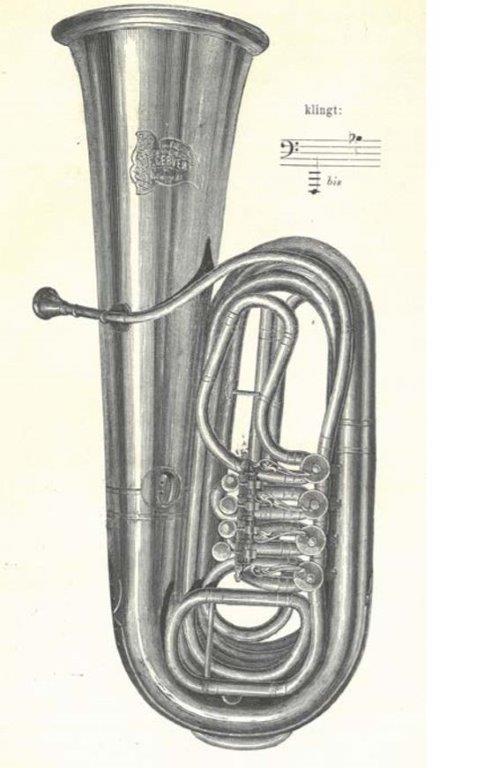
But tradition also counts for a lot, and doesn't have to have a design reason. Here is the contrabass tuba from Cerveny, the inventor of the contrabass tuba, about 30 years after its invention:
Image

In the 140 or 150 years since this instrument, not much has changed in the basic architecture of a German-style rotary tuba. Is that commitment to a design, or a statement about the effect of tradition? I suspect the latter. As Bloke says, don't screw with success.

Now, what does it take to drain water from the leadpipe? A quick tilt to the left.

Rick "who has owned a number of these types of instruments and played them routinely in cool, humid environments, and this is not where water collection has been a problem" Denney
User avatar
pjv
4 valves
4 valves
Posts: 879
Joined: Sun Jul 11, 2004 4:39 am

Re: water filling mouthpipe

Post by pjv »

I find it interesting how many reactions have been "if there's water in the mouthpipe, then empty it".
Obviously, and we are all adult enough to figure out where when and how to do this.

The question about why it's made like this has been answered I believe; somewhere between "tradition" and "never change a winning team".

My quibble is clear, though I didn't go into details like when you get a dump of water back down your throat while playing. This certainly happens to me at least 3x a year and probably also has something to do with the mouthpipe being very horizontal. So if I happen to have moved my body backwards a bit, for whatever reason (most people move a bit while playing, especially during a long haul) this could happen. I've missed notes because of this.

But it appears that I'm almost the only one on this board that's dealing with. So I deal with it.

I didn't mention just irritating aspects, like when I quickly move to write something down on my music and in this proces have moved my tuba up straight and a bit to the right it dumps water through the mouthpipe and mouthpiece onto my shirt. But....I can live with that!
User avatar
Donn
6 valves
6 valves
Posts: 5977
Joined: Fri Aug 19, 2005 3:58 pm
Location: Seattle, ☯

Re: water filling mouthpipe

Post by Donn »

Rick Denney wrote: 7. Valves in the correct portion of the bugle not to upset the intonation of the tapered bugle (also often enough not fulfilled).
Is that a fairly well understood parameter, such that we could for example gauge for ourselves whether a particular tuba is correctly designed? No difference between rotary and piston valves, I assume.
bloke wrote:The most annoying thing about typical front-action piston tubas is that water collects in the #1 and #2 slide circuits, and it WOULD drain, were those pistons able to be ported in a different way.
If I'm thinking of the same thing, it's one reason I'm glad to be rid of my old King 1250 - and just looking at pictures, I've had the impression that the Reynolds valves for their similar tuba would not have that problem so much.
User avatar
Rick Denney
Resident Genius
Posts: 6650
Joined: Mon Mar 22, 2004 1:18 am
Contact:

Re: water filling mouthpipe

Post by Rick Denney »

Donn wrote:
Rick Denney wrote: 7. Valves in the correct portion of the bugle not to upset the intonation of the tapered bugle (also often enough not fulfilled).
Is that a fairly well understood parameter, such that we could for example gauge for ourselves whether a particular tuba is correctly designed? No difference between rotary and piston valves, I assume.
No. And there are many non-linear interactions that confound modeling, despite the software that currently exists. But that’s the reason for tradition—formulas arrived at by experimentation cost a lot, and are therefore preserved in use. We generalize based on that, but we still evaluate each instrument individually, noting differences between apparently identical tubas. Obviously, more than one formula “works,” though with a different set of compromises.

Rick “too many variables” Denney
User avatar
P@rick
bugler
bugler
Posts: 209
Joined: Wed Feb 28, 2007 5:00 am
Location: The Netherlands

Re: water filling mouthpipe

Post by P@rick »

pjv wrote:...when you get a dump of water back down your throat while playing...and...when I quickly move to write something down on my music and in this proces have moved my tuba up straight and a bit to the right it dumps water through the mouthpipe and mouthpiece onto my shirt...
I feel your frustration. I'm also familiar with this kind off anoyens.

There are a few german style tuba's which don't have the water trap and I can think of other solutions to the problem (like the Hirs 390 mouthpipe curl with spitvalve)...but why most tuba manufacturers disregard the issue with the water trap in their designs...I can only guess...

Still not helping :( :wink:
Three Valves
6 valves
6 valves
Posts: 4230
Joined: Wed Jan 07, 2015 9:44 am
Location: With my fellow Thought Criminals

Re: water filling mouthpipe

Post by Three Valves »

NO!! :tuba:
I am committed to the advancement of civil rights, minus the Marxist intimidation and thuggery of BLM.
User avatar
pjv
4 valves
4 valves
Posts: 879
Joined: Sun Jul 11, 2004 4:39 am

Re: water filling mouthpipe

Post by pjv »

Seeing as most German tubas also sport the tall bell design, I surmise that placing the mouthpipe higher up on the bell would allow the manufacturer to avoid the upslope.
I’ve taken a “piece-of-string” measurement on two of my tubas and the mpc placement is comfortably acceptable, assuming one has no issues with placing their tuba on the chair instead of their lap.
This to me is two advantages as an aging tuba player:
1 I the quite regular back and forth choreography needed to empty they mouthpipe fill-up at the “dip” have now been resolved.
2 the tuba is off my legs. Not all German tubas are light.
At the end of the day, I prefer that my physical and mental energy have been spent concentrating on the music, and not with other distractions.
Post Reply