bloke wrote:Exactly.
The water aspect may well suck, but there probably aren’t too many other places to put that capillary portion of the instrument - on a large vertical main slide B-flat tuba - without screwing up hand position.
Yes. Let's consider the requirements:
1. Receiver on one end that accepts a (semi)standardized mouthpiece shank.
2. Valve bore on the other end in the 19+mm range.
3. Sufficiently anchored to minimize fragility.
4. Mouthpiece receiver at the humanoid height (and this requirement is often enough not fulfilled).
5. Valves located approximately coincident with human hands, and preferable the same human whose mouth is on the mouthpiece.
6. Bugle length 18 feet.
7. Valves in the correct portion of the bugle not to upset the intonation of the tapered bugle (also often enough not fulfilled).
8. Taper design that provides good intonation.
9. Taper design that produces a characteristic tone (as in, spectral content).
Considering all those requirements, let's look at instruments with short leadpipes. The typical piston tuba has a short leadpipe (16-1/2 inches in the case of the formerly mine York Master), but also has a smaller valve bore, and is designed with a fast taper. The fast taper and bell shape provides a characteristic tone. The typical rotary tuba has a much longer leadpipe (27-1/2 inches for the formerly mine Miraphone 186) and a larger valve bore. The taper is even faster, though, because the instrument postpones the taper to farther along the bugle. Again, this design provides a characteristic tone, but which is different from the typical piston tuba of similar overall size.
We can make a rotary tuba have a short leadpipe. Consider the B&S F tuba, where the leadpipe typically comes into the side of the fifth valve (which is the top valve even on six-valve models) rather than the top. With these tubas, the first, fifth, and sixth valves are a smaller bore than valves 2-4, which are progressively larger. Thus, this instrument has a unique taper design. Newer versions that enlarged those first three valves in the airstream created a different set of compromises, and have a different characteristic tone and intonation. On most Bb rotary tubas, which have four valves, the leadpipe approaches the first valve from the top. That means it has to have a dip in it that holds water to fulfill all the requirements.
But tradition also counts for a lot, and doesn't have to have a design reason. Here is the contrabass tuba from Cerveny, the inventor of the contrabass tuba, about 30 years after its invention:
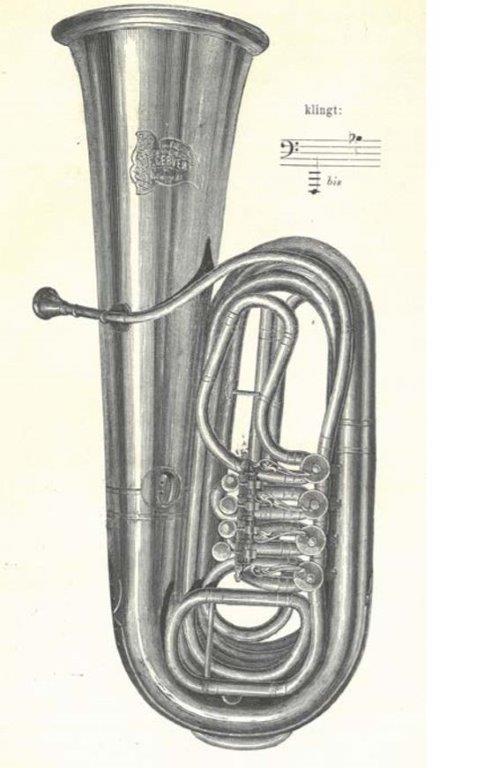
In the 140 or 150 years since this instrument, not much has changed in the basic architecture of a German-style rotary tuba. Is that commitment to a design, or a statement about the effect of tradition? I suspect the latter. As Bloke says, don't screw with success.
Now, what does it take to drain water from the leadpipe? A quick tilt to the left.
Rick "who has owned a number of these types of instruments and played them routinely in cool, humid environments, and this is not where water collection has been a problem" Denney


 that would defiantly be a benefit when my right neighbor would be a trombonist, but my wingman on the right is a tuba player


